This is not the typical blog about makeup, hairstyles or fashion. Here I will speak, from my personal experience, of issues related to beauty and health that are not that known. I share my wisdom with the hope that it will help you to avoid complexes, annoyances and money.
In this month’s post I am going to expose my thoughts and opinions about things that have to do with feet, those great forgotten parts of our body during the winter and that much to my chagrin I am forced to see/endure in summer.
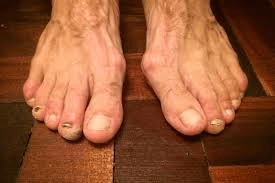
Feet in general disgusts me. I know it’s just another part of the body, but the ass is too, and people don’t show it around. Exaggerations aside, I really have a low tolerance for seeing feet, especially big, hairy men’s feet. Not to mention feet with fungus, long nails, etc…disgusting!!
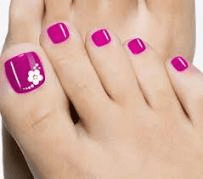
As an exception, I love baby feet, and well-groomed women’s feet with painted nails, ok, I can stand that. But now it seems that it is fashionable to go barefoot, as it is very hipster, very naturist and I don’t know what else, and what it seems to me is dirty. You go with your feet picking up all the dirt from the floor. For example, I have become fond of watching a YouTube channel about cleaning called Clean my Space, in which the girl is very funny, explains very useful things and you can see that she is groomed, with her makeup and hair done for her videos. But she always goes around barefoot! I can’t understand it, let’s see, if you go out in a video mopping to explain how to clean wooden floors, how is it possible that you go barefoot while doing it? Your house will be very clean, but surely your feet won’t… I wrote asking but she never answered. Another thing is to go barefoot with socks on, that may be more tolerable, especially if you are in a room with a carpet or so. But, and above all, being in the kitchen or in the bathroom barefoot, even with socks, seems disgusting to me (in addition, we must add the greater danger of electrocution if one goes barefoot, because you lose insulation from the floor that sleepers provide).
Cute
Acceptable
Disgusting
I had a French teacher who once spoke about this topic, and he said that it was something cultural that happens to us Spaniards. That once he was in a summer course where the teacher came barefoot and that no one was bothered except a Spaniard who began to look disgusted. This teacher said that feet do not have to be disgusting, that they do not smell “unless they are sick”…well, I refer back to the comparison with the ass. Yes, obviously, on the beach you go barefoot, that’s normal. And now there are some theories that talk about getting barefoot on the grass so that the soles of your feet (which according to reflexology reflect all the points of the body) come in contact with the vibrations of the earth or something like that, something related to negative and positive ions. That could be accepted too, fresh grass can be nice to walk on barefoot. But I also heard about a trend that advocates always going barefoot, summer or winter, and I also heard that argument saying that not going barefoot is like always wearing gloves, but on your feet. Well, I seldom leave my feet in the air, not even to sleep, and nothing has happened to me (nor to the appearance of my feet either: in fact, this way, no corns or calluses appear).
Anyway, I am referring above all to social situations/outside of nature such as meetings, classes, or even inside the house, where I do not see acceptable that people go barefoot. Not to mention if I’m eating, I don’t eat if I have to be watching feet at the same time (I refer for the third time to the comparison with the ass). Sure, in summer, with the heat, I can’t forbid people to wear sandals or flip-flops (I like them to), but people should at least they have the consideration of leaving their feet on the ground and not putting them on the table or raised to eye level. No need to say when they start to touch them, arggg Just like people who bite their fingernails (arggg again). I have never understood why those things are more socially accepted than burping or farting (while these two are much more physiologically justifiable). There are people who even spit their nail out after biting their fingernails, without any regard.
Anyway, to my joy, summer season is over and I won’t have to see more feet until next year yuhuuuuuuuu !!!
Hello! In this month’s post I am going to talk about noise pollution and silence. I love silence. It’s not that I don’t like music, but I love being at home, or at work, and that there is silence. I don’t like working with music or noise. When I move to a new house (and I have lived in a few since I was a student and later with my jobs around the world), I worry a lot about if my new home is, for example, near a pub, shopping street or road, about what kind of neighbors I have, etc. I get stressed by traffic noise and by having noisy neighbors, or by being forced to listen to anyone’s privacy. Anyway, part of this “mania” comes from when I had to suffer a neighbor who spent her time having sex at full blast and hitting the wall next to me, to the point that I had to move. It was useless talking to her. I really think after that I developed some kind of post-traumatic stress. However, the noise of babies and children does not bother me so much.
For quite a few years, I believe that since I was a student, I often sleep with earplugs. I found that they helped me to rest better, since my parents’ house overlooks a road and when I slept late or took a nap the noise bothered me. I use foam earplugs. I tried one of those silicone tailor-made earplugs, which are more hygienic, but they didn’t remove noise better. Besides, they fell off from my ears and the foam ones did not. Foam earplugs are the ones that seal the ear the most and can be washed (although I think they lose effectiveness). Since they cost very little, I wear them for about two weeks and move on to another pair. I wonder if by putting the earplugs so far in, I might be creating earwax plugs or preventing the earwax from coming out. I have always thought that I would exchange my myopia for hearing worse, because unfortunately it turns out that I hear excessively well.
If only houses were better made. I was in one that had double windows and yeah, there was really an isolation from the noise of the street, it was amazing. Also, walls and ceilings could be thicker, especially on the floors so as not to have to listen to the neighbors or be heard. Although what I see is also a lot of lack of manners, especially in people who listen to music at full volume and at times that are not appropriate. Another issue, it is assumed that in the future electric cars will no longer make noise … hopefully someone will invent bluetooth car horns, hahaha.
But since trying to change people is useless, I wanted to share some technological solutions that I found on the internet. Apparently, what traditional earplugs do is to reduce noise, they cannot eliminate it completely. For example, the earplugs that reduce the most noise reach approximately 32 decibels. That is what they take away from the noise there is, but absolute silence is impossible because one would begin to listen to their own blood circulation. I wonder if that’s what you hear when you hear a seashell, as a kid I was always told that what we heard are sea waves 😊
The fact is that some devices have already been invented, and they counteract external noise. That is, they cancel the waves of the outside noise and generate waves in an opposite phase, canceling or mitigating the incoming waves. I read about a device that was worn at home to mitigate the noise that enters through the window, but it seems that where this technology has been most developed is in headphones. These are headphones designed so that you can listen to your music without turning it at full volume because you are on the subway, for example. They cancel out outside noise. The ones I found are from the Bose brand and are called Quietcomfort. Opinions on this are very good. A man says he puts them on to walk around Barcelona so that he doesn’t get stressed out by noise.
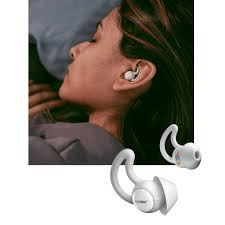
But the newest thing that interests me the most are the sleeping plugs that this brand has released. They are quite new and at the moment they are only sold in the United States, but if they are really effective, the two hundred euros they cost would not hurt so much. Some opinions that I have read say that it changes lives. A lot is said about exercise and eating to have a healthy life (mainly focusing on being thin), but not much attention is paid to the need to sleep enough and well and to be relaxed, which I think is as important or more for health.
Apparently there has already been some other similar initiative by some Asians, but it seems that they did not have a very good customer service. The idea regarding these earplugs, which in the case of Bose are called “Wireless Noise-Masking Sleepbuds”, is to carry earplugs with wireless technology with up to 16 hours of battery life (so that they last all night and more). They incorporate wave technology to counteract outside noise by emitting soft white and relaxing noises (such as ocean waves, rain …). You can configure them to sound the alarm clock, so that they don’t wake your partner up. The device promises to cancel outside noises and snoring. It seems great to me (I know that snoring causes problems for couples, and I didn’t think about the alarm thing, since I always hear it when it sounds, even with my earplugs). But I wish I didn’t have to hear any noise (not even the white noise). Apparently, this is not possible. I have tried the white noise thing before (for example, the kitchen extractor) and it is true that it isolates other noises quite a bit and that it relaxes. The hair dryer also produces that white noise, so effective in putting babies to sleep. And, paradoxically, the engines of such annoying cars, which is why I think being in a car makes me so sleepy.
High technology earplugs
Finally, I hope this technology will improve. I find it incredible that with so many people living in big cities and crowded in apartments, houses continue to be made with walls and windows that seem like paper. And those of us who rent do not have the option of doing works to isolate the house from noise. The rudeness of some with the issue of noise is also quite incredible … I just hope that, since entrepreneurship and start-ups are so fashionable, some enlightened person creates that artifact and/or cutting-edge technology that allows people to sleep in absolute silence.
UPDATE!!: I finally bought a white noise machine and it is what I’ve been using when there was noise outside or from neighbors. White noise is the noise that babies hear when they are in their mother’s womb, it is the background noise of the waves of the sea, the kitchen extractor, the hair dryer, even the car engine noise makes me sleep…a noise that relaxes and covers other noises. They say it also helps babies sleep.
*To buy the products I speak about (I only recommend products that I’ve tested):
As an Amazon Associate I earn from qualifying purchases
This month, and as I already announced, I am going to talk about a method that I have found to reduce myopia.
In another post I talked about my experience with the topic of myopia, glasses, contact lenses, laser surgery … and I asked if anyone had a positive experience with any eye exercises. Well, those exercises have been around for a long time, they’re called the Bates method. In fact, today there is even a specific “yoga” for the eyes.
But that’s not what I’m going to talk about. What I have found is a method that I found researching on the Internet, which is quite logical to me and about which there are many testimonials of success. I’ve been applying it for some months, and when I had my annual vision checkup this year they told me that my eyesight was noticeable better. In fact, for the first time in a while it has not worsened, in fact it had gone down by 0.25 diopters. The idea is, if myopia arises and worsens because the eye “lengthens” itself, can’t the opposite also happen? Can’t it be made to happen?
The method has been “invented” by an American named Jake Steiner, and basically what he explains is that often the opticians prescribe an “overcorrection” of myopia, designed to see with a quality of 100% at a distance, and that makes us see worse and worse, because what we use glasses and contact lenses for (apart from driving) are often close-up activities (computer, mobile, etc …). What Jake explains is that many times it begins with a very low myopia that is due to an overexertion of the eye, and which could be corrected by itself with good lighting, looking into the distance, taking breaks when looking closely, practicing “active focus” when we look into the distance… But what happens is that we go to the opticians and they put glasses on us, we always wear that correction (regardless of the activities we do, and which are often “close up” activities ) and that means that in our next visit to the optician, myopia has increased. And so begins a vicious cycle in which we see worse and worse (the exception to this, as I have read in some testimonies, would be the hormonal changes of pregnancy, which often cause increases in myopia, but like other effects of pregnancy, I guess they revert later).
The solution he proposes is to measure oneself for myopia (you can have Snellen tests at home) and to wear 3 types of glasses: one with the maximum correction or the one recommended in the optician to see 100% in the distance if we have a job that requires it or to drive; other with half a diopter less than the first to see from afar but not perfectly; other with a diopter and a half less than the first for all close-up activities (computer, TV, being at home …). If you use contact lenses instead of glasses, bear in mind that the required prescription for lenses is 0.25 less than glasses, because contact lenses are glued to the eye.
With the method Jake proposes, the idea is to improve vision and reduce myopia by 0.25 diopters every three or four months or so. Thus, in a year we should reduce 0.75 or 1 diopter. He also says that once we have two diopters, we better try not to use anything for close-up activities.
The biggest problem with this method would be the cost of having so many different glasses and gradually changing them every few months. Jack criticizes the business of opticians and glasses, and proposes to buy glasses online. I have done it on the Zenni Optical website. There you put the graduation you want and you only need a pair of glasses that you already wear: the measurements are already on the temple. The web explains very well how to do it.
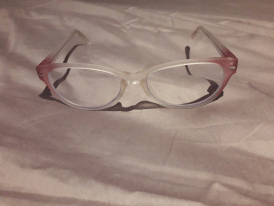
To give you an idea, I bought two pairs of glasses, each pair cost me 40 dollars. My prescription was 5.25 in the left eye and 4.75 in the right eye. But for one year I had been wearing my old glasses, which had a prescription of 4.25 in the left eye and 3.75 in the right (I had already guessed something about this issue of not carrying the full prescription for close up activities). Well, I ordered two pairs of the same frame glasses, one with a 4.25 to see from afar and another with a 3.50 for home and close up activities. I also ordered new contact lenses for 4.25 diopters (they are also cheaper online). Note that I do not drive, so I do not need a perfect distance vision at any time. It’s been two months now and, as I told you, the checkup at the optical shop went very well (I didn’t tell them anything about the experiment I’m doing).
Honestly, it was silly to buy two pairs of glasses, because I don’t use the 4.25 pair (to see farther), since for the street I always wear contact lenses. When I work or I’m at home I put on my 3.50 diopters glasses.
My 40$ glasses
Well, I am quite happy with how the process is going, I recommend trying it to everyone, also to parents whose children begin to see badly (Jake also talks about this issue). I link here his website and youtube page. He also has a private Facebook group, where people talk about their experiences and raise questions. I recommend that you read it carefully and slowly, so that you understand everything.
And if you are not convinced, I also link the page (in Spanish) of an optometrist who, although it has nothing to do with Jack’s method, gives very good advice on taking care of eyesight (for example, he talks about the issue of humidity and its relationship with dry eyes, the influence of screens on visual problems:
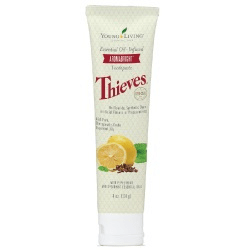
This month I am going to tell you about the last trick that I am applying. It was not my discovery because I found it on a YouTube channel where a girl was talking about the uses she gave to her organic toothpaste. One of them was as a deodorant, applying some toothpaste to each armpit. She assured that it was the best deodorant she had ever tried, that she spent hours and hours moving and zero odor, and that it also worked for her husband.
I have tried it and it works very well, at first you notice a sensation of “mint”. You better not try this with pastes that contain fluoride and strange things, since everything is absorbed through the skin. It must be some kind of “natural” tootbrush. In the one I used, the first ingredients, after water and calcium carbonate, are coconut oil and bicarbonate. What a surprise! Just the ingredients of the homemade toothpaste that I have been using successfully for years. Although in this other post I told you about simply using baking soda as a deodorant, I think that the toothpaste deodorant is more effective for hot months.
Since a glass jar with coconut oil that melts and solidifies according to the temperature of the place and a toothbrush that must be taken with a teaspoon every time I brush my teeth is not something very practical to travel or to have at work, I also buy toothpaste for these cases and now, as a deodorant !! The only thing I don’t like about organic pastes is that they usually contain glycerin, and I understand that this substance sticks to the teeth and is not very beneficial. But hey, it’s not that I use it all the time.
Toothpaste and deodorant, 2×1
I hope it works for you and that you tell me about it!!
*To buy the products I speak about (I only recommend products that I’ve tested):
As an Amazon Associate I earn from qualifying purchases
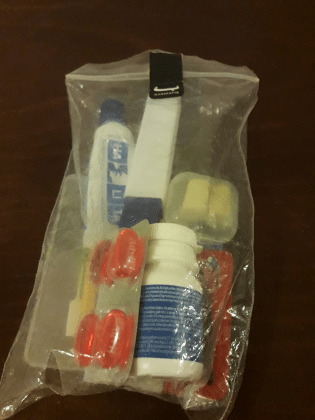
In this post I am going to talk about the emergency bag to carry in your bag. One day, on a YouTube channel, I saw a tip that I found very useful, and yet it had never occurred to me: to have an emergency bag to pass from one bag to another. The girl explained that this way you save time preparing what you are going to take every time you change your bag, and you avoid forgetting important things. You simply change the emergency bag from one place to another. I don’t normally use it, but I always carry it with me, in case I end up sleeping out of home or have an emergency.
Here I am going to share what my emergency bag contains (each one can adapt it to their needs, of course):
* Omeprazole and ibuprofen pills. If you read my post about the period, you know the problems I have, so I always carry some pills with me.
* A panty liner. For the same reason. I do not wear a sanitary towel because it is more bulky, and if my period comes suddenly, it does not start from the first moment like an open tap. When the date approaches, I add some sanitary towels to my bag, and I always have them on my worktable’s drawer too.
* A pair of hair ties and four hairpins. There must be a parallel universe of hairpins and hair ties, but it has happened to me to need them and not have them… so never again.
* A couple of plasters. Very useful especially in the summer period, when ballet flats or sandals can cause unexpected rubbing.
* A travel toothbrush, a small travel toothpaste and an interdental brush. I usually put the kind of pastes given away on airplanes or when buying toothbrushes. I already explained which toothpaste I use (coconut oil + bicarbonate), but since this is only “just in case”, I those small toothspastes I have at home.
* A box with earplugs. Usually I cannot sleep without my earplugs, and I wear them in case I sleep out of home.
My emergency bag. You can also use a less tacky toiletry bag :)))
And if you have the misfortune of being short-sighted like me, you can also carry another bag with a case of contact lenses and a small bottle with liquid (the very very small ones that come in little cases, or carry the little case the case directly). This also in case we sleep out of home or a contact lens suddenly starts bothering us. This should be in a separate bag, just in case liquid is spilled. By the way, I already published a post about vision, but soon I will publish a post about how to reverse myopia (yes, it is possible !!!).
Well, apart from this, I carry a lipstick for my lips, but not in the emergency bag because I do use it regularly (Dr. Burt’s Bees brand, don’t use petroleum derivatives). Many would add a mirror, but I don’t because mirrors are everywhere and you can use your phone’s camera.
I hope you find it useful!
Regards!!
*To buy the products I speak about (I only recommend products that I’ve tested):
As an Amazon Associate I earn from qualifying purchases
In this post I am going to talk about the bra and its relationship with the lymphatic system. And why it is good NOT to wear a bra. Feminist arguments about not wearing bras or makeup, about how bras and heels are instruments of the “oppressive patriarchy” (I love saying this, hahaha), are quite right, whether you support feminists or not (debate in which I will not enter and that seems absurd to me, obviously you must support feminism).
Well, focusing on bras. Depending on one’s breast size, a bra is more or less necessary. As I have small boobs, I really wear it more for aesthetic reasons (for clothes to fit well) than out of necessity. In fact, the 3 things I always do when I get home are: take off my shoes, take off my contact lenses, and take off my oppressive bra (hahaha). I understand that a girl with big boobs has more need to wear it, also to fight against the force of gravity (which will end up winning the battle anyway).
There are different types of bras: with wire, without wire, with padding, without padding … A bra without underwire or padding is much more comfortable, but those of us who have little boobs need that extra help to look good with cleavage, with certain shirts…It is also true that we have a pre-established image of the shape boobs should have (the round one of the bra cup) that is not the true one, because if we were not wearing a bra, at least in my case, the shape would be more or less pointed. But I still don’t dare to not wearing bra when I’m wearing only a shirt. The good thing is that in winter, when you wear a lot of clothes, you can really go without it.
I have even taken off my bra while at work because I felt it bothered me. It was something I hadn’t thought about much, but online I found that there is a reason for this: wearing tight things hinders the circulation of the lymphatic system. Lymph flows through the body and wearing tight clothing and bras makes it difficult for it to flow well. In addition, there have been studies that relate whether or not to wear a bra with the presence of nodules on the chest, which is not a joke. I am going to attach here the information from Rawvana’s video about the bra and from Elsa Pataky’s post in which she talks about how to take care of the lymphatic system (with dry massages and lymphatic drainage):
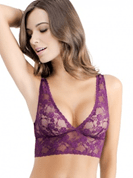
To finish, my recommendations are: do not wear a bra at home or to sleep, opt more for sports or bralette types and use the uncomfortable-padded-wire only for social occasions that require it: to show off, to suffer? Rarely.
Bralettes are more comfortable than traditional bras, and some of them can be weared as tops
Until next time!!
*To buy the products I speak about (I only recommend products that I’ve tested):
As an Amazon Associate I earn from qualifying purchases
I am going to dedicate this post to the subject of sight, from my point of view (worth the redundancy!). Rather, it will be an essay with my experience and reflections on the topic of myopia, glasses, contact lenses and Lasik surgery.
It is clear that the percentage of people who use glasses/contact lenses has increased a lot in recent years, and I am sure it has to do with the lifestyle of working with the computer, smartphones … despite all the advantages that this gives us. Despite all good things (to me, the Internet is one of the best inventions of history) it had to have some disadvantages, and I think that it does not affect sight it in a positive sense. Our eyes are prepared to look into the distance, as when we lived in nature, but today we are all the time with our eyes fixed on very close and small objects. Decades ago, only older people wore glasses, for tired eyesight. Today almost everyone has a fault in their eyesight. Although luckily glasses are no longer awful but a fashion accessory, and contact lenses give us a lot of comfort. Some recommendations for day to day are: take short breaks from the computer and look into the distance, install a yellow light filter for the computer (this also helps to prevent blue light from keeping us awake at night) and lower the brightness of electronic devices. Also take advantage of natural light whenever possible to illuminate your space.
I had good eyesight until adolescence, when, like so many others, after a visit to the optical shop I went out with glasses “just to study and watch TV.” I had little myopia, less than 1 diopter in each eye. Over time, myopia increased, to the point that one day I did not recognize my mother when she was walking in the opposite direction down the street. She thought it was too sad and she told me to either put on my glasses for the street or put on contact lenses.
Obviously no way I was going to go with glasses on the street, I had enough with my teenage insecurities at that time (acne, orthodontics …) to wear glasses. I didn’t want to be Ugly Betty! I know that now with all the hipster fashion and such it is very well seen to wear glasses, but I do not look pretty with them, to be honest. Also, in the case of myopia, glasses make eyes look smaller, and for one thing that I like about my face …
Luckily I had no problem learning how to wear contact lenses. Luckily, because one day we tried to get my brother (who has not had vision problems) to put on those colored lenses, in blue, to see how he would look with blue eyes, and there was no way. It was impossible for him to allow a foreign object to come into contact with his eyes.
Well, and so the years went by and unfortunately myopia increased … the constant use of screens (computer, now smartphone …) didn’t help very much. The fact is that today (32 years old) I have 4.75 in one eye and 5.25 in another, and when I get the annual check-up at the optical shop I start to tremble with fear that my diopters have risen again.
What I do is wearing contact lenses when I’m out and glasses at home. I actually have older glasses with a lower prescription than what I now use for contact lenses, and I use them to be at home (at home I don’t need to see well from afar). I have the newest glasses with the graduation that corresponds to me for “just in case”: in case I have a problem with contact lenses and I can’t put them on for the street, for when I travel and I plan to fall asleep … But I don’t like wearing glasses outside. Not only for aesthetics reasons, but also because I don’t see them as practical as contact lenses: it is not practical if you practice sports, or if you go to the beach (tip: wear diving goggles if you bathe with contact lenses), or if it is winter and your glasses fog up when entering indoors, even worse if it rains … Wow, I see a lot of drawbacks. Besides, I already have considerable myopia, if I wear glasses I have to lower my head like a fool to be able to go down the stairs properly, for example. With glasses you do not have the same panoramic vision as with contact lenses.
Luckily over the years contact lenses have improved a lot, and for example the ones I have now are made of silicone hydrogel and you can wear them for many hours without discomfort (I wear them all working day, until I get home). By the way, they are much cheaper if you buy them online (same brand). What I do is always carry a small refillable bottle with a little liquid and a case of contact lenses in my bag, in case something happens (it starts to bother you and you have to take it off, you stay to sleep at someone’s home…). Anyway, bad vision is a handicap, for example when traveling, having to carry the glasses, the contact lenses, the case of contact lenses, that “wait,-I-go-to-the-bathroom-to-take off/put-on-my-contact lenses” at the airport or bus station … a pain.
And yes, I already looked for surgery, but it turns out that I had not gone to a review for the previous two years (mea culpa! You should check your vision once a year) and my graduation had gone up a lot. I was advised against having surgery, mostly because if you haven’t had a stable prescription for at least two years, you may have surgery and have to keep wearing glasses/ contact lenses afterwards. In addition, in the case of women the issue of pregnancy is added. It is proven that many women’s myopia is affected during pregnancy (more for the worse than for the better). But my optician told me about a case in which a girl’s graduation dropped a lot after pregnancy, that’s luck! I also kind of believe in conspiracy theories on this topic: if there was a definitive solution for vision problems, what would eye doctors live on? And if Lasik surgery is effective, why almost no eye doctor operates himself? What’s more, why do they wear glasses? Is not a bit contradictory?
There is information on the Internet that says that the eyes, like the brain or the heart, are basically “muscles”, so they must be used so that they do not atrophy, and train them in the appropriate way. This would make perfect sense to explain the prevalence of myopia today. You just have to Google “myopia cure exercises” and you will find gurus, magic solutions and opinions of all tastes. I am quite skeptical that there may be a natural way to cure myopia (hopefully though). But the truth is that since I started investigating things on my own and not trusting so much what is taken for granted or the medical/pharmaceutical discourse (I recognize its importance but my personal experience makes me trust their opinion very little), many myths and assumptions have fallen for me (such as the use of deodorant or toothpaste; and of course the myth that acne problems, and especially hair, are solved with pills).
Continuing with the theme of having surgery, what I have thought is to wait until I am in my 40s, at an age when I already know that I will not have more children. If I have been like this for 15 years, I don’t mind another 10. And as technology in this is improving, it will surely be better in a few years: the first myopia laser operations “eroded” the cornea, now the technique used is a”flap” of opening and closing (according to my profane knowledge). And it turns out that when I did the tests they also told me that I have a “thin” cornea in terms of thickness, meaning that I am “operable” but they would not advise me to operate twice.
And yes, the issue of glasses and contact lenses is an expense and a nuisance, but if I am not going to amortize the money from the surgery, it does not compensate me either. On the other hand, taking into account my fondness for electric hair removal, it turns out that it is an activity in which you have to see well up close (although you can use magnifying glasses), and it turns out that precisely those nearsighted people see very well up close. Anyway…
I would like people who read this post and have something to contribute to tell me about their experience. Above all, I would like to know about the people who have had surgery (honestly please, I know that nobody likes to admit that they made a mistake or threw their money away), if they have returned to have some diopters (even if it is little, I know that this happens ). And, for the “moles” who have been mothers, whether they have had surgery or not, how this has affected their myopia: if it went up or down. It is something that I ask whenever I have the opportunity but here perhaps I could gather more information. And of course, if someone has had results with miraculous gymnastics for their eyes.
I am going to dedicate my first post to hydration: inside and outside.
I think more attention is paid to external hydration than to internal. I was recently on a trip with a friend, and I observed that every day, before getting dressed, she put cream to hydrate her entire body and face. However, throughout the day, despite the hot weather, she hardly drank any water. Instead of water, she drank coffee and beer, depending on what time it was (both drinks dehydrates). And she was surprised that I always drank water with my meals.
Hydration, both internal and external, is very important, but I think internal hydration is more important than the external one. We are 70-80% water, and that water must be replaced throughout the day, especially if we are in a hot environment. If it is cold, it is normal that we are less thirsty, but we must drink the same (if we want hot drinks, we can do it in the form of tea or infusion) and our skin can look dry due to heating. If it is hot, we will naturally be thirstier, and if we sunbathe our skin will dry out more than if we are in the shade. In the case of children and the elderly, it is necessary to ensure that they drink water, especially the elderly, as they have a decreased sensation of thirst.
My trick to staying hydrated is to try to drink water every half hour (two sips). I drink water in the morning before breakfast (after rinsing my mouth with coconut oil), and at work. I have my water bottle (not plastic) to try to drink every half hour. Obviously if I’m on the street I can’t do this, but there is also the option of carrying a bottle of water in your bag. The green juices I have for dinner (two or three glasses) also hydrate. When you drink too much alcohol and coffee, or simply don’t drink enough water, it reflects on your energy and the condition of your skin.
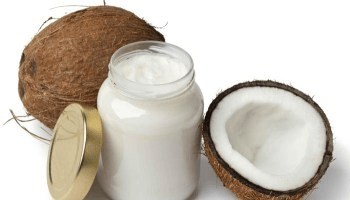
Moving on to external hydration, I hydrate my face and neck in the morning and at night. I only use some good aloe vera (from my aloe vera plant), and lately, because I’m in my thirties, a little coconut oil at night, mainly in the eye and forehead area (I’m still scared that I get a grain for being oil, although not yet). I also hydrate my lips with coconut oil. And at night I put coconut oil on my hands, elbows, knees, and feet, before I go to sleep.
What I don’t normally do is hydrate my whole body. Why? Well, because it involves time and expenses on the product (even if it’s coconut oil) that I don’t want to assume. My face and hands are constantly exposed to the outside, so it makes sense to hydrate them daily. Elbows, knees and feet require very little amounts, and I hydrate them daily to prevent callus. But for the body, which is normally covered and only gets soaked briefly in the shower, I don’t see the need to use moisturizer (I don’t rub soap all over my body every day, just occasionally; I use soap only in private parts and armpits).
Of course, it would be another thing if, for example, I went swimming or to the beach to sunbathe, then I would hydrate my body too. But normally I don’t do that. And my skin is very soft (to a great extent thanks to the electrolysis hair removal). On TV and in pharmacies they sell us the idea that it is necessary to smear ourselves with creams every day (tonics, nutritive creams, eye contours, bla, bla, bla). Well look, it is not like that, and I have verified it in myself (in addition, creams are usually made of petroleum derivatives that seal the skin like a plastic). With a few products (aloe vera, coconut oil) normally applied only to the face, neck, hands and troubled areas, it is enough. And when the age is really noticeable (which will be less if the sun does not shine on our faces) it is better to go once or twice a year to one of those places that inject vitamins and all that stuff on your face, than to spend that money on creams. Anyway, I hope in my case that will be, at the earliest, at 40.
So, in conclusion, more internal hydration and fewer complications with the external one.
Until next time! 🙂
*To buy the products I speak about (I only recommend products that I’ve tested):
As an Amazon Associate I earn from qualifying purchases
It is said that the hands reveal the age of a person: a lady may have put botox, acid, vitamins and things like that on her face, have a facelift … and even tough the appearance of her face is that of someone younger, her hands provide a clue about her true age. This is because hands don’t receive much attention and, even when they do, it is difficult to make hands “appear younger” than their age (however, I have heard that infiltrations exist also for hands).
Hands have hardly any fat or collagen, so the aged appearance is noticeable earlier. Older people often have brown spots on their hands, just as on the face. These spots, as I said in a previous post, can be removed with the electric hair removal machine (although I suppose there will also be laser methods).
Although the advice that I am going to give seems quite obvious, I want to remember some things here precisely because I see many people who do not follow them every day:
1. Protect your hands from cold weather. Especially in winter months, never forget your gloves! Cold weather causes hands to become dry, scaly and rough.
2. Protect your hands from the sun. I already explained previously that I am not in favor of applying sunscreen every day, that this type of recommendation seems to me somewhat interested from people who want to sell creams (in addition to many other issues regarding their ingredients). My advice is to walk in the shade and to be protected with an umbrella, which also works for the rain. Besides, I use hats! I leave sunscreen only for situations in which I am going to be directly exposed to the sun for a long time (beach, swimming pool …). If we use umbrellas hands are already protected in the shade. But if your hands are going to be exposed to the sun, remember to also put sunscreen on your hands.
3. Use gloves for housework. It horrifies me when I see people washing dishes without gloves, exposing their hands to hot water and the chemicals in dish soap (it is better if you have a dishwasher, it saves water and involves less work for you). The same when we clean the house or wash clothes by hand. I have a hairdresser friend with shattered hands, because of course, she spends the day washing heads … in this case I don’t know if there will be any type of suitable gloves for it, but it would be recommended.
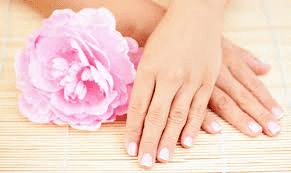
4. Hydrate your hands. Just as you wash your face and moisturize it at night, do the same with your hands. We wash and dry our hands several times a day, so they need extra hydration. Coconut oil is good for it. If you prefer creams (I am quite anti-creams), one that seems awesome to me is Neutrogena. Or you can just put petroleum jelly (although petroleum jelly is derived from petroleum and I’m a bit anti-it too).
5. Wash your hands! Well, this no longer applies to hand care but we all know that it is a basic hygiene measure: wash your hands before eating, cooking, after going to the bathroom, changing diapers or playing with the dog … Outside home it is always better, if we have the option, to dry our hands with paper than with hot air (it dries out the hands). And if it is not so easy to find a sink, antibacterial gels are a good option, they do not need rinsing and can be carried in your bag. And another tip that may also seem obvious but it is not so obvious: you have to wash your hands before washing your face or applying moisturizer or makeup. That is, our hands are clean when we put the soap with which we are going to wash our face, moisturizer or makeup. UPDATE!!: This post was written long before Covid-19, but this last recommendation seems more useful than ever.
*To buy the products I speak about (I only recommend products that I’ve tested):
As an Amazon Associate I earn from qualifying purchases
Today’s post is about an issue that terrifies me since I was little and continues to worry me today: parasites inside the human body. I suppose everyone has been told as children that if you eat a lot of sweets you get “worms”. I never had it, I guess it really helped that I didn’t eat a lot of sweets as a child.
Now that I am an adult and I know more about life (hehehe) I already know that there are different types of parasites, and that they are usually acquired by eating raw-poorly cooked food, poorly disinfected vegetables or fruits, water in poor condition …
Another story that has always terrified me is that of the tapeworm. The idea that you can have a “worm” of a few meters inside your body, without knowing it, for years … bufff. I have heard many stories about this, sometimes from close people (I’m not sure if I believe them). From models who acquired the tapeworm “on purpose” to be able to eat a lot and be thin, to the grandmother whose tapeworm peeked through one nostril and got into the other nostril … Also the story of people who were put face down, with their mouth open and a bowl of water or milk, so that the tapeworm would come out to…The story of a woman who had a tapeworm inside her for 10 years and whose tapeworm came out one day while she was taking a shower…Or the story that says that if you open your mouth after eating cod, which is very salty, the tapewrom comes out to drink from the glass of water. Hahahaha they seem like camp horror (or laughter) stories!!
Tapeworm
But the fact is that it does exist, and if you have it, it is not that serious: you take a pill, it dies, and you will shi it tup. Among the tapeworm, amoebas, worms and others, I have been living in distress every time I went to the bathroom, in case they appeared, hahaha.
Another important fact is that in countries that are not as temperate as Europe, the United States or Japan (those that have seasons), that is, those countries that are rather tropical, the incidence of parasites (also transmitted by mosquitoes, although this is another issue ) is quite bigger. Not only because of the hotter climate (apparently the “bugs” die in cold weather) but because of their habit of eating in the street, in places with hygienic-sanitary measures that leave much to be desired.
When you are going to travel to one of these countries, at the vaccination center they recommend you to drink only bottled water (some exaggerated one that I know went to Ecuador and even washed her teeth with bottled water), not to eat on the street, and better not to eat fruits and vegetables (unless you eat disinfected and peeled fruit). I very much agree with these measures, and not only in tropical countries. In fact, when I eat out in Spain and Europe (although not in street stalls) I don’t usually order salads or fruits. Why? First, I don’t eat out every day, so since I am paying a plus I prefer something more substantial than a salad (I already eat vegetables every day at home). Later, because I don’t know how they disinfect raw foods, if they wash their hands before handling them, if they wear gloves… Since I heard the story of a “funny” man who worked at McDonalds and spit on hamburgers, well… That’s why I love places where they cook pizza or whatever in front of you.
And well, in tropical countries, if you live there or are there for a long time, you surely will end up eating somewhere where hygienic-sanitary measures are not what we are used to in Europe. You just have to go around the municipal markets, they have made me want to vomit seeing how they have raw meat lying there, without cold or any protection measure. But … it would be a shame to miss the local gastronomy for that. So, I sometimes eat in street stalls in these places, but trying to make sure it a trustworthy place, that both the product and the person cooking look good, and I do it very rarely. Another fact to take into account is that in these countries people are “dewormed” like dogs. Every six months or year they take a deworming pill, because they assume that they have caught something, or as a precaution. WTFFFF !!!




 en.secretsbeautyandhealth.blog