This is not the typical blog about makeup, hairstyles or fashion. Here I will speak, from my personal experience, of issues related to beauty and health that are not that known. I share my wisdom with the hope that it will help you to avoid complexes, annoyances and money.
In the last post of this strange year 2020 I want to share that I have written a book!! It is not my first book, but it is the first that I did not write for work reasons and that I’m publishing as Mariahelpsyou. It is available in Spanish and English, both in ebook and paper format. For every taste!
The possibility of self-publishing for free with Amazon had caught my attention a long time ago. Knowing the difficulties of gaining a foothold in the publishing world, it seems like a great option for all those who want to publish something that may not sell, or who are not professional writers. Taking advantage of the low social life imposed this year, I took on the task of compiling some of the blog posts into a book, which has the same title as the blog. It is a short book, with eight chapters, with the posts I thought were the most important to include. In the five years that have passed since I started writing the blog I discovered new things and I had to update several posts. So, in the book I wanted to include all that information together. For example, how I progressed with electrolysis hair removal, belonephobia, skin care, in dyeing my gray hair, in oral care…
The book is aimed especially at teenage girls and girls in their twenties. Every time I wrote a blog post, I mentally relived my past dealing with different beauty / health issues, and each time I thought: “If someone had told me this at the time.” I remembered how I felt so lonely and hopeless with certain problems, which apparently only happened to me because nobody around was talking about them, and that despite my many attempts seemed to have no solution. Some of them (like acne or gingivitis) may seem more common and not as serious. Others, like hirsutism or belonephobia, have really embittered much of my life. That is why the book is aimed at young girls who may living a similar situation. Although it has taken many years, I have found a solution to all these problems. And it has not been thanks to the many specialist doctors, or dentists, or hairdressers, or any so-called “professionals”, but only with my persistence and research on the Internet, losing a lot of time and money along the way. Whoever seeks finds (even if it is later than sooner). Although the book is aimed at young girls, of course anyone can benefit from reading it, at least one chapter, be it a man or a woman of any age.
And well, what better date to launch a book than before Christmas! I do not expect to earn lot of money with this, it would be enough for me to know that the knowledge I share arrived and helped someone who needed it.
Merry Christmas!!
*Where to buy the book:
As an Amazon associate I earn from qualifying purchases.
In February 2018 I wrote a post talking about what it means to be myopic (glasses, contact lenses, Lasik surgery…). Obviously, myopia and its incredible increase in the world population has a lot to do with the modern office/screen/smartphone lifestyle. In July 2018 I wrote a post explaining Jake Steiner’s anti-myopia method (which you can follow on YouTube and his website endmyopia.org). With only a few months applying this method (to the best of my possibilities) I already had a decrease of 0.25 in my myopia.
I think there is a lot of ignorance and conformity regarding myopia. Nobody stops to reflect on whether it is normal for their eyesight to worsen year after year, even when they are young, or whether it is normal to be prescribed more and more diopters each time they visit the optician, with the consequent change of glasses and financial outlay. Which by the way is an abuse, glasses are simply lens with an anti-reflective coat, and the profit that the opticians get for selling them, with respect to the cost of production, is insulting. Most 400 and 500 euros glasses should not cost more than 50, what people pay for is an enormous increase in the price of a few simple lenses and the brand of the frame. Glasses, more than an instrument to see better, seem to be traded as if they were luxury items, such as brand bags. I no longer buy glasses at an optical store but online with Zenni Optical.
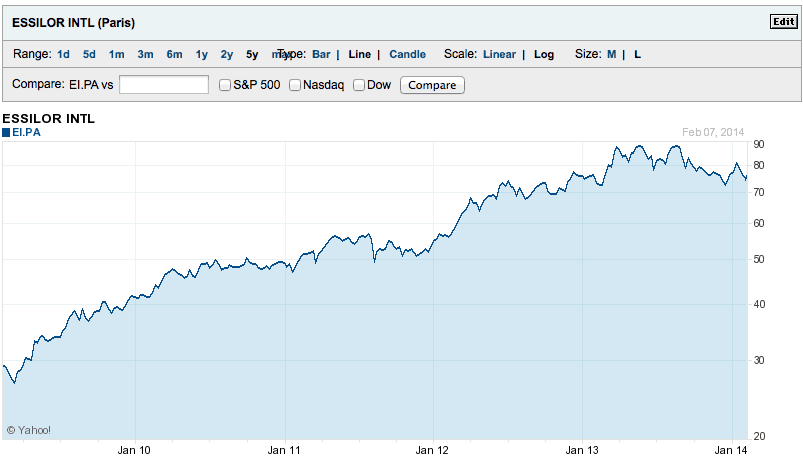
Essilor is a company listed on the French stock market, dedicated to manufacturing lenses. You can see how lucrative the business is.
People also do not stop to think that it is not the same to look far as to look closely, that the correction for myopia is to see well from a distance (ex: driving) but it is not so necessary to see well up close (in fact, it makes vision worse and worse). I have learned all this by following Jake’s videos and website, and now I can confirm it from my own experience. I have also discarded the idea of Lasik surgery. I know that it is a blessing for the quality of life of people with high myopia and that many have done well, but the truth is that what this operation does is giving you a result like wearing contact lenses permanently, in the sense that you see well, yes, but your eyeball is still elongated and your risk on the retina remains the same. The idea of curing myopia is not only to see well again, but also that the elongation of the eyeball changes very slowly and the risk of retinal problems is reduced.
For several years I had been going to work all day in front of the computer, in rooms with heating/air conditioning and with contact lenses, and that is terrorism for your eyes. When you are using the computer/smartphone you blink less and the eye dries, and it dries even more with contact lenses. Heating and air conditioning also dry out the environment, so you should always have a humidifier or a container full of water in the room.
Contact lenses give a better field of vision than glasses and are perfect for the street, going downstairs and playing sports, and for when you really need to see very well from a distance. But to be at home, to work closely, to read, to sew, to perform my dear electric hair removal…no (for that, good magnifying glasses are best). Myopia glasses are for myopia, not for seeing up close. What I started doing almost 3 years ago is to use glasses with a lower prescription than what I use in contact lenses (around one diopter less). And to wear those glasses for close up activities and to be at home. Since this summer I had a “nose job” and wearing glasses is not allowed for a while, I “jumped into the pool” and stopped wearing any type of correction at home. And it was hard, because it is not that I have a little myopia. Today I have a prescription of 4 and 4.5 (when I wrote my first post about myopia, I was 4.75 and 5.25, so you can see that I have improved 0.75 in each eye, in a little less than 3 years). My glasses to be at home and work closely were in 3.25, and I went from that to nothing. I’ve been like this for 5 months now, and I’ve gotten used to it, incredible. I wouldn’t have believed it if someone had told me, because for years the first thing I did when I got out of bed was to put on my glasses. I don’t wear glasses at home or to work. It was quite hard at first, my head ached from the effort, but I got used to it. I get a little closer to the computer screen, but by zooming I have solved it quite well. This may seem silly but what a difference! When looking at the internet, click on the three vertical points in the upper right part of the browser, and then zoom to the maximum that allows you to read the page well. Before I used to read everything at the default size, which is tiny, and of course I had to get very close to the screen. If you spend a lot of time surfing from one page to another, it can be uncomfortable to keep an eye on the zoom, but it is not my case. Also, to write in Word, you can enlarge the screen at the bottom right (I have it at 212%).
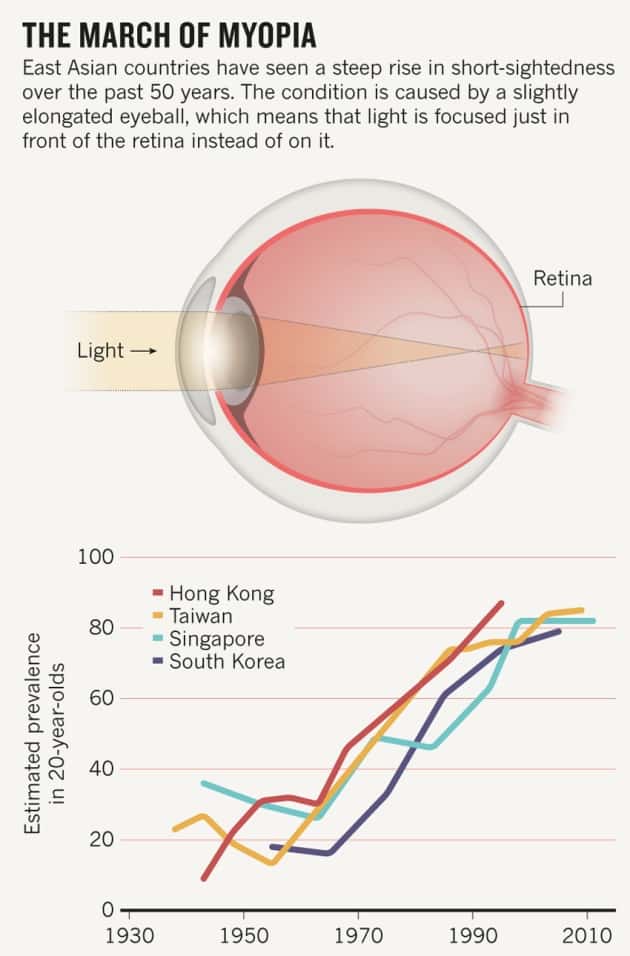
There will be people who think that myopia is not a problem beyond the aesthetic issue and the discomfort of walking around with glasses/contact lenses. But you have to be careful when myopia goes beyond 6 or 8 diopters. In that case, it is already what is called high myopia and there is a risk of retinal detachment and even blindness. It’s not a joke. Only a small percentage of the population has myopia in a hereditary/natural way, in most people it is due to the habits acquired over the years and the increasing correction that they wear all day. It is like type 1 and 2 diabetes, the second is acquired and can be corrected. But correcting it takes years and effort to change habits, just as it took me years to start from 0.25 and “just to study and watch TV” to be at 5 diopters and feel disabled without my glasses. You just have to see that the generation of current grandparents, for the most part, never wore glasses to see from afar, but only the correction to see closely when getting old (that is a natural problem, of aging). Asian populations, due to their physiognomy (elongated eyes) have a much higher risk of developing high myopia. Look at this figures, they are outrageous:
Image taken from Jake Steiner’s webpage: Brutal increase in myopia in Asian populations, hand in hand with development and modern lifestyle.
Returning to high myopia, the myopic eye is longer than the non-myopic eye, and that makes the retina thinner and therefore more prone to detachment. In fact, high myopic pregnant women are sometimes even recommended cesarean section instead of natural delivery because of the risk of retinal detachment. For people with high myopia, “violent” activities such as parachuting, roller coasters… are also discouraged due to the risk of retinal detachment.
Since I wrote the first posts about myopia (February and July 2018) to today (November 2020) I have incorporated many new habits to my way of managing myopia. And I have reduced it by 0.75 in each eye, not more because my lifestyle/work inevitably involves working closely, but enough to realize that increasing or decreasing myopia is like gaining/losing weight: a matter of habits. That is why I am going to leave here a list of things that I have learned should be done to improve eyesight. Almost everything I have learned is from Jake Steiner’s videos/web. I hope it’s useful!
1. Begin to wear only glasses (not contact lenses) for office/close-up work: glasses at least 1 diopter less than your current prescription. Glasses should have a clear frame, be as light as possible and with large enough lenses.
2. If possible, try not to wear even glasses for office/close-up work. This is easier when your diopters are low, although I have done it with quite a few but because I am currently working remotely, I understand that in an office it is more complicated.
3. Wear contact lenses outdoors (they provide a broader field of vision) and with total correction for activities such as driving. Indoors, try to have natural light. Try to do fewer close-up activities at night, and if you do them, always use good lighting (don’t look at the computer/smartphone in the dark and with the brightness at the highest).
4. Buy cheap glasses, it can be done online or even in optical stores if they have modest models. The idea with the Jake Steiner method is that diopters are gradually reduced, perhaps 0.25 every 6 months or 1 year. That implies changing glasses once or twice per year.
5. Enlarge the Internet pages, Word … to see them as large as possible when you are working. If possible, use large monitors, the problem with this is that they can induce looking up and to prevent dry eye it is better to look slightly down. This is because looking up opens the eye more and looking down your eyelid covers the eye more, which therefore dries less.
6. Use applications to have breaks when using the computer (with protectyourvision.org every 20 minutes an alarm sounds, so that you look 20 meters away and blink for 20 seconds). Control the brightness of the screens (at night you should reduce it). I recommend the Flux application, which adjusts the brightness level according to the time of day, making the screen more yellow at night (to avoid blue light at that time, which also causes insomnia).
7. Control the humidity level in the room so that the environment is not too dry, do not wear contact lenses indoors. Outdoors, too much sun, wind or pollution also damages dry eye, wearing sunglasses can help.
8. Try to be outside at least 1 hour a day, for example, walking, to look into the distance. Let it be daytime, of course. This, so simple, is difficult for me to accomplish. If you are accompanied, you can do the same as with glasses: even if you wear contact lenses, wear them with a slightly less prescription than prescribed to make a little more effort when looking into the distance. Or if you have low myopia you can even go without graduation, as long as you are accompanied or it is not necessary to see perfectly well.
9. I love reading. And that adds close-up viewing time to what I already have to invest for work. The solution is audiobooks. In addition, this way you can kill two birds with one stone: you can take the opportunity to listen to your audiobook while you walk or are outside and look into the distance. There are many books available in audiobook on Audible. YouTube videos can also be converted to an mp3 version to listen to. The Voice Aloud Reader application reads pdfs aloud, you can select at what speed, mark where you have stopped… I use this application to listen to books that I have in pdf from my smartphone, while I exercise, do chores at home, while I’m waiting in a line…And it’s totally free.
10. Visit the ophthalmologist once a year. It is not enough to go to the optical store. Many opticians are skeptical about the idea that myopia can be improved (obviously it does not suit them for their business) and it may be that in the checkup, if they already know your prescription, they will not tell you that your prescription has dropped. To fix that, you can change your optical store each year and “lie” to them about your current prescription when they have your vision checked. I would not worry too much about this question if you are not a person who drives or performs risky activities that require perfect vision from a distance. The ophthalmologist is going to tell you what your real prescription is. In addition, he looks at the back of your eye to check that your retina is fine, and this is very important. If the ophthalmologist detects micro-tears in the retina, it can be fixed with a laser intervention and prevent a bigger problem.
This month’s post is going to be a compilation of everything I’ve been writing about on the blog, since I started with three posts in 2015, until I decided to take it more seriously and write a monthly post as part of my goals for the year in 2017.
When I started the blog I wanted to share things that I had discovered by myself, especially through the Internet and from my own experience and that of others, over the years. They were doubts, questions that do not appear so much in beauty magazines and on blogs and YouTube channels, or that in the case of appearing I considered they had wrong or incomplete answers (such as taking the pill if you have acne or resorting to laser if you have hair on your face…). I really wanted to address problems and solutions that I thought were not being publicized enough.
In 2015 I explained how the irrigator (in its eco-friendly and cheap version, the Italian So-Wash) is the secret weapon that dentists do not want you to discover, along with the coconut oil + bicarbonate toothpaste. A toothpaste that also works as a deodorant. I also published the most visited and consulted entry of the entire blog, the one that talks about electrolysis hair removal. A post that I updated later showing the progress of my “do it yourself” results in this regard.
In 2017, I started talking about my experience with hirsutism and acne, I defended Roacutan and Ovusitol against the contraceptive pill and I talked about some simple and cheap measures like aloe vera, castile soap (Dr. Bronners), the importance of changing face towels and the pillowcase (better if it is made of silk) often. I have also talked about the importance of nutrition (the now fashionable smoothies) for the skin and the little-known mineral makeup.
I also talked about health issues, such as period pain, and how I try to control them by always keeping omeprazole and ibuprofen close at hand, in my emergency bag. Or the problem of belonephobia, so poorly treated by most health professionals and which causes serious trauma to many people. I still hadn’t found a definitive solution to this issue, but reading the book Overcoming Medical Phobias gave me some hope. Trying psychological treatments (hypnosis, neurolinguistic programming) gradual exposure (with images, videos…) and using the applied tension of the muscles could be the key. In my case, I also think that choosing a different site from which to draw the blood (perhaps the hand and not the inside of the elbow) could have an influence. I’ve been working on this for the past few months, and I’ve gone from feeling a bit dizzy just reading or watching videos about it, to being able to tolerate it (at least from a distance). I also think that the time of day influences, since for example I have the lowest blood pressure and I am weaker in the morning, which is precisely when the blood extraction procedure is done (and on an empty stomach). A reader advised me to use Buzzy and I have it ready to try in the future. What I’d really like to try though is the Seventh Sense Biosystems TAP. I keep writing them to see how to acquire it but it seems that at the moment only certain laboratories have it (I have also written to them and they do not respond). I hope it is only a matter of time, because it gives me the impression that there may be the solution. Other alternatives are the use of Vacutainer or butterfly needles for extractions. I had considered these alternatives, so I would also like to try. Anyway, hopefully in the future I can write a post explaining how I finally solved the issue. It would be my personal big hit on these issues, along with the discovery of electrolysis :))
Some posts include novel therapies, such as the natural solution to myopia (including much cheaper glasses), a problem that I had previously discussed. In this regard, I recently read a piece of news about some drops to solve myopia developed by a university in Israel … I’ll be watching too. Hopefully ending myopia without surgery will my third hit :))
*To buy the products I speak about (I only recommend products that I’ve tested):
As an Amazon Associate I earn from qualifying purchases
This month, and as I already announced, I am going to talk about a method that I have found to reduce myopia.
In another post I talked about my experience with the topic of myopia, glasses, contact lenses, laser surgery … and I asked if anyone had a positive experience with any eye exercises. Well, those exercises have been around for a long time, they’re called the Bates method. In fact, today there is even a specific “yoga” for the eyes.
But that’s not what I’m going to talk about. What I have found is a method that I found researching on the Internet, which is quite logical to me and about which there are many testimonials of success. I’ve been applying it for some months, and when I had my annual vision checkup this year they told me that my eyesight was noticeable better. In fact, for the first time in a while it has not worsened, in fact it had gone down by 0.25 diopters. The idea is, if myopia arises and worsens because the eye “lengthens” itself, can’t the opposite also happen? Can’t it be made to happen?
The method has been “invented” by an American named Jake Steiner, and basically what he explains is that often the opticians prescribe an “overcorrection” of myopia, designed to see with a quality of 100% at a distance, and that makes us see worse and worse, because what we use glasses and contact lenses for (apart from driving) are often close-up activities (computer, mobile, etc …). What Jake explains is that many times it begins with a very low myopia that is due to an overexertion of the eye, and which could be corrected by itself with good lighting, looking into the distance, taking breaks when looking closely, practicing “active focus” when we look into the distance… But what happens is that we go to the opticians and they put glasses on us, we always wear that correction (regardless of the activities we do, and which are often “close up” activities ) and that means that in our next visit to the optician, myopia has increased. And so begins a vicious cycle in which we see worse and worse (the exception to this, as I have read in some testimonies, would be the hormonal changes of pregnancy, which often cause increases in myopia, but like other effects of pregnancy, I guess they revert later).
The solution he proposes is to measure oneself for myopia (you can have Snellen tests at home) and to wear 3 types of glasses: one with the maximum correction or the one recommended in the optician to see 100% in the distance if we have a job that requires it or to drive; other with half a diopter less than the first to see from afar but not perfectly; other with a diopter and a half less than the first for all close-up activities (computer, TV, being at home …). If you use contact lenses instead of glasses, bear in mind that the required prescription for lenses is 0.25 less than glasses, because contact lenses are glued to the eye.
With the method Jake proposes, the idea is to improve vision and reduce myopia by 0.25 diopters every three or four months or so. Thus, in a year we should reduce 0.75 or 1 diopter. He also says that once we have two diopters, we better try not to use anything for close-up activities.
The biggest problem with this method would be the cost of having so many different glasses and gradually changing them every few months. Jack criticizes the business of opticians and glasses, and proposes to buy glasses online. I have done it on the Zenni Optical website. There you put the graduation you want and you only need a pair of glasses that you already wear: the measurements are already on the temple. The web explains very well how to do it.
To give you an idea, I bought two pairs of glasses, each pair cost me 40 dollars. My prescription was 5.25 in the left eye and 4.75 in the right eye. But for one year I had been wearing my old glasses, which had a prescription of 4.25 in the left eye and 3.75 in the right (I had already guessed something about this issue of not carrying the full prescription for close up activities). Well, I ordered two pairs of the same frame glasses, one with a 4.25 to see from afar and another with a 3.50 for home and close up activities. I also ordered new contact lenses for 4.25 diopters (they are also cheaper online). Note that I do not drive, so I do not need a perfect distance vision at any time. It’s been two months now and, as I told you, the checkup at the optical shop went very well (I didn’t tell them anything about the experiment I’m doing).
Honestly, it was silly to buy two pairs of glasses, because I don’t use the 4.25 pair (to see farther), since for the street I always wear contact lenses. When I work or I’m at home I put on my 3.50 diopters glasses.
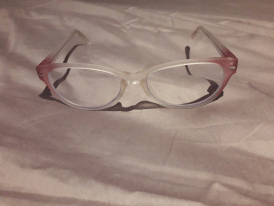
My 40$ glasses
Well, I am quite happy with how the process is going, I recommend trying it to everyone, also to parents whose children begin to see badly (Jake also talks about this issue). I link here his website and youtube page. He also has a private Facebook group, where people talk about their experiences and raise questions. I recommend that you read it carefully and slowly, so that you understand everything.
And if you are not convinced, I also link the page (in Spanish) of an optometrist who, although it has nothing to do with Jack’s method, gives very good advice on taking care of eyesight (for example, he talks about the issue of humidity and its relationship with dry eyes, the influence of screens on visual problems:
I am going to dedicate this post to the subject of sight, from my point of view (worth the redundancy!). Rather, it will be an essay with my experience and reflections on the topic of myopia, glasses, contact lenses and Lasik surgery.
It is clear that the percentage of people who use glasses/contact lenses has increased a lot in recent years, and I am sure it has to do with the lifestyle of working with the computer, smartphones … despite all the advantages that this gives us. Despite all good things (to me, the Internet is one of the best inventions of history) it had to have some disadvantages, and I think that it does not affect sight it in a positive sense. Our eyes are prepared to look into the distance, as when we lived in nature, but today we are all the time with our eyes fixed on very close and small objects. Decades ago, only older people wore glasses, for tired eyesight. Today almost everyone has a fault in their eyesight. Although luckily glasses are no longer awful but a fashion accessory, and contact lenses give us a lot of comfort. Some recommendations for day to day are: take short breaks from the computer and look into the distance, install a yellow light filter for the computer (this also helps to prevent blue light from keeping us awake at night) and lower the brightness of electronic devices. Also take advantage of natural light whenever possible to illuminate your space.
I had good eyesight until adolescence, when, like so many others, after a visit to the optical shop I went out with glasses “just to study and watch TV.” I had little myopia, less than 1 diopter in each eye. Over time, myopia increased, to the point that one day I did not recognize my mother when she was walking in the opposite direction down the street. She thought it was too sad and she told me to either put on my glasses for the street or put on contact lenses.
Obviously no way I was going to go with glasses on the street, I had enough with my teenage insecurities at that time (acne, orthodontics …) to wear glasses. I didn’t want to be Ugly Betty! I know that now with all the hipster fashion and such it is very well seen to wear glasses, but I do not look pretty with them, to be honest. Also, in the case of myopia, glasses make eyes look smaller, and for one thing that I like about my face …
Luckily I had no problem learning how to wear contact lenses. Luckily, because one day we tried to get my brother (who has not had vision problems) to put on those colored lenses, in blue, to see how he would look with blue eyes, and there was no way. It was impossible for him to allow a foreign object to come into contact with his eyes.
Well, and so the years went by and unfortunately myopia increased … the constant use of screens (computer, now smartphone …) didn’t help very much. The fact is that today (32 years old) I have 4.75 in one eye and 5.25 in another, and when I get the annual check-up at the optical shop I start to tremble with fear that my diopters have risen again.
What I do is wearing contact lenses when I’m out and glasses at home. I actually have older glasses with a lower prescription than what I now use for contact lenses, and I use them to be at home (at home I don’t need to see well from afar). I have the newest glasses with the graduation that corresponds to me for “just in case”: in case I have a problem with contact lenses and I can’t put them on for the street, for when I travel and I plan to fall asleep … But I don’t like wearing glasses outside. Not only for aesthetics reasons, but also because I don’t see them as practical as contact lenses: it is not practical if you practice sports, or if you go to the beach (tip: wear diving goggles if you bathe with contact lenses), or if it is winter and your glasses fog up when entering indoors, even worse if it rains … Wow, I see a lot of drawbacks. Besides, I already have considerable myopia, if I wear glasses I have to lower my head like a fool to be able to go down the stairs properly, for example. With glasses you do not have the same panoramic vision as with contact lenses.
Luckily over the years contact lenses have improved a lot, and for example the ones I have now are made of silicone hydrogel and you can wear them for many hours without discomfort (I wear them all working day, until I get home). By the way, they are much cheaper if you buy them online (same brand). What I do is always carry a small refillable bottle with a little liquid and a case of contact lenses in my bag, in case something happens (it starts to bother you and you have to take it off, you stay to sleep at someone’s home…). Anyway, bad vision is a handicap, for example when traveling, having to carry the glasses, the contact lenses, the case of contact lenses, that “wait,-I-go-to-the-bathroom-to-take off/put-on-my-contact lenses” at the airport or bus station … a pain.
And yes, I already looked for surgery, but it turns out that I had not gone to a review for the previous two years (mea culpa! You should check your vision once a year) and my graduation had gone up a lot. I was advised against having surgery, mostly because if you haven’t had a stable prescription for at least two years, you may have surgery and have to keep wearing glasses/ contact lenses afterwards. In addition, in the case of women the issue of pregnancy is added. It is proven that many women’s myopia is affected during pregnancy (more for the worse than for the better). But my optician told me about a case in which a girl’s graduation dropped a lot after pregnancy, that’s luck! I also kind of believe in conspiracy theories on this topic: if there was a definitive solution for vision problems, what would eye doctors live on? And if Lasik surgery is effective, why almost no eye doctor operates himself? What’s more, why do they wear glasses? Is not a bit contradictory?
There is information on the Internet that says that the eyes, like the brain or the heart, are basically “muscles”, so they must be used so that they do not atrophy, and train them in the appropriate way. This would make perfect sense to explain the prevalence of myopia today. You just have to Google “myopia cure exercises” and you will find gurus, magic solutions and opinions of all tastes. I am quite skeptical that there may be a natural way to cure myopia (hopefully though). But the truth is that since I started investigating things on my own and not trusting so much what is taken for granted or the medical/pharmaceutical discourse (I recognize its importance but my personal experience makes me trust their opinion very little), many myths and assumptions have fallen for me (such as the use of deodorant or toothpaste; and of course the myth that acne problems, and especially hair, are solved with pills).
Continuing with the theme of having surgery, what I have thought is to wait until I am in my 40s, at an age when I already know that I will not have more children. If I have been like this for 15 years, I don’t mind another 10. And as technology in this is improving, it will surely be better in a few years: the first myopia laser operations “eroded” the cornea, now the technique used is a”flap” of opening and closing (according to my profane knowledge). And it turns out that when I did the tests they also told me that I have a “thin” cornea in terms of thickness, meaning that I am “operable” but they would not advise me to operate twice.
And yes, the issue of glasses and contact lenses is an expense and a nuisance, but if I am not going to amortize the money from the surgery, it does not compensate me either. On the other hand, taking into account my fondness for electric hair removal, it turns out that it is an activity in which you have to see well up close (although you can use magnifying glasses), and it turns out that precisely those nearsighted people see very well up close. Anyway…
I would like people who read this post and have something to contribute to tell me about their experience. Above all, I would like to know about the people who have had surgery (honestly please, I know that nobody likes to admit that they made a mistake or threw their money away), if they have returned to have some diopters (even if it is little, I know that this happens ). And, for the “moles” who have been mothers, whether they have had surgery or not, how this has affected their myopia: if it went up or down. It is something that I ask whenever I have the opportunity but here perhaps I could gather more information. And of course, if someone has had results with miraculous gymnastics for their eyes.



 en.secretsbeautyandhealth.blog