Hello everyone!!
In a previous post, I talked about the belonephobia that I have suffered since I was a child, a problem that has caused me to pass out after having blood tests, even going so far as to have convulsions. This problem is not “a child’s thing” as many think/scoff, since it is suffered by more than 20% of the ADULT population, leading to avoiding medical check-ups and generally lasting for life. Or not: I am not sure that I have completely “overcome” this problem (regretting it, I do not think I will ever become a blood donor) but I have found one, rather several, solutions, and recently I was able to verify that they work in rhinoplasty (that would be the subject of another post), for which, as is done in all operations, I had a blood test and an intraveous (which stayed there from before the operation until the next day). It should be noted that I had never had surgery with total anesthesia, nor had I been hospitalized or with an IV on my arm. All this added to my already known fear of blood tests, which were done on the same day of the surgery in the morning (the surgery was in the afternoon). The whole process, from the blood test to the surgery to the post-surgery, went well, at no time did I panic, nor did I get dizzy, nor did I pass out or anything. And that has been a SUPER ACHIEVEMENT for me, perhaps one of the greatest achievements of my life.
Once the context is explained, I will explain point by point the things I did to face the operation (the last thing I worried about was how my nose would look, hahaha). I cannot say for sure which of the things worked more or less, phobias have a great psychological component and, in the case of belonephobia, they have physical consequences (dizziness, fainting …), so it is difficult to know which factor can work for whom. I have been researching what could be done for a long time and I am sure that some things will be a novelty.
1. Psychological preparation: knowing what happens in belonephobia and how to avoid it. A characteristic feature of belonephobia compared to other phobias is fainting, the so-called vasovagal syncope. This occurs because the nervousness itself causes blood pressure to rise and then fall suddenly at the time of the blood draw, leading to what is fainting itself. In fact, the fear of needles is not so much a fear of needles or blood itself, but a fear of pain and especially of fainting. That is why I love and do electrolysis hair removal to myself, an activity that in some way involved the use of “needles”, and at the same time I have belonephobia. Belonephobia and fainting are usually a family issue, something that is inherited. The technique that is recommended to avoid vasovagal syncope is “applied tension”, a technique that consists of tightening the muscles of the legs, trunk and arms (not in the extraction arm) at the time the extraction is taking place, so that the maintenance of high blood pressure is artificially caused, avoiding fainting. The book where I learned it is called Overcoming Medical Phobias (available electronically). In this book they also talk about gradual exposure, a psychological technique that is used for other phobias as well. A phobia is an extreme fear. Fear has an evolutionary reason: to save us from danger, either by fleeing or fighting. In the case of belonephobia, the fear of fainting, or of the pain of extraction, causes blood pressure to rise and then fall rapidly. Gradual exposure tries to reduce or eliminate that fear. In my case, what I did was watching videos of blood draws and IV insertions. At first I got a little dizzy and had to lie down quickly on the bed, but after repeating it I improved. Also, watching the videos helped me to normalize the situation. The videos I watched were these:
Aprende extracción de sangre
Aprende extracción de sangre con palomita
Aprende a canalizar vía intravenosa
2. Having breakfast. The fact that most blood tests require fasting does not help, since many people have lower blood pressure in the morning and that , added fasting (possible hypoglycemia) and nervousness…I want to emphasize (and it is something that is seldom said) that NOT ALL BLOOD TESTS REQUIRE FASTING. In fact, I had my pre-surgery blood test after having a good breakfast, and that helped. Then I did the 6 hours of fasting(without drinking water) that must be done before surgery. In general, fasting before blood tests is required so that the resulting values are not altered, and especially to test glucose levels. But, for example, a hormonal analysis may not need to be done on an empty stomach. Neither pre-surgery blood tests, which I suppose will evaluate clotting. Glucose, I think, can be assessed with a fingertip test, which could avoid the fasting and requirement for common blood tests in people who have a hard time, by doing the glucose test with a fingertip stick.
3. Take a tranquilizer. On one of the occasions when I passed out with convulsions after a blood test, the nurse suggested that in the future I should take a tranquilizer before taking blood tests, since it would not affect the results. It worked a couple of times, then I forgot to do it or I didn’t have it (these pills require a prescription). On previous occasions, what I took was Diazepam (I don’t remember how many grams): one the night before to sleep well and another the same day before going to have my blood test. On this occasion, the surgeon himself had given me a tranquilizer (they generally do it with all patients, even if they do not have belonephobia, because being calm helps the surgery go better). It was called Lexatin and it was 3 mg. I could have taken it the night before, but I preferred to take it in the morning with breakfast, since I had surgery in the afternoon and I was afraid it would be too many hours for the effect to last if I took it the night before. When I took Diazepam, perhaps because I was taking two, the feeling was similar to being drunk, not euphoric but kind of groggy and happy, and a bit clumsy. But this time I didn’t feel any of those things, I was just calm, but more normal than with Diazepam. I recommend reading the instructions carefully to see how long the tranquilizer takes to have its maximum effect and for how many hours it lasts, and thus calculate when to take it.
4. The usual recommendations. I don’t want to miss common recommendations that are also very valid, such as asking to be laid down on a stretcher (specially to avoid hitting yourself in the event of fainting) and getting up slowly after the extraction. Also think about other things, be distracted, do not look… If you have to do the blood test on an empty stomach, have a chocolate to eat immediately after the extraction.
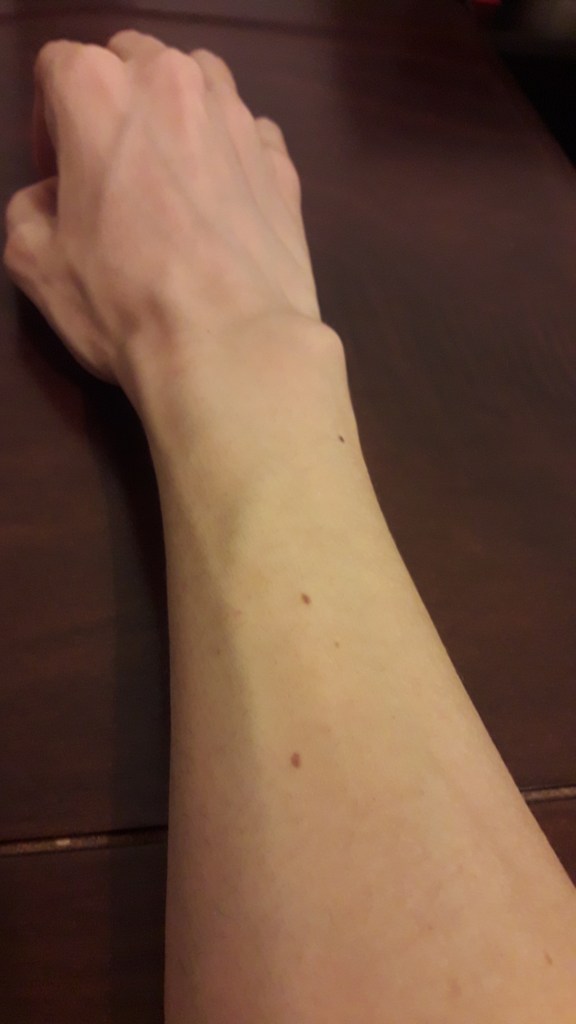
5. Try other extraction sites. The inside of the elbow is the most common place for extraction, because there is a thick vein that looks good and in theory it hurts little because it is quite protruding. But this is not always the case for everyone. I already had my suspicions that my problem with blood draws could have to do with the collection site, and I have practically confirmed that it is true. Surely you are familiar with the story that if you squeeze a person in I do not know what points of the neck they will faint immediately. Well, I have the impression that something similar happens to me with the inside of the elbow. And I am quite convinced because once I fainted after having my blood pressure taken, since the doctor had squeezed the inside part of my elbow with the auscultation device. One of the readers of this blog told me that blood tests can also be done by extracting blood from other places, such as the back of the hand. Looking on the Internet, I saw that young children often have their blood drawn with a “butterfly”, which is like a butterfly with a finer needle that draws blood from finer veins (like those on the back of the hand). Then that blood goes through a tube into the sample tube. When I watched the extraction videos, I was much less impressed to see extractions from the back of the hand than from the inside of the elbow. On the surgery day I told the nurse that I had to lie down, that I tend to dizziness (you always have to tell them this) and that I wanted them to extract my blood with a butterflywinglet from the back of the hand. She was somewhat reluctant; I suppose because for them the usual practice is much easier and faster. But she agreed and proceeded to do so. It did not hurt at all more than the inside of the elbow (I had asked in many nursing places on the Internet and they always told me that the back of the hand hurts more). But unfortunately, something happened, the tube broke and she had to start again. In spite of all this, I was still calm (I had taken the tranquilizer), trying to stress my legs and trunk and not looking at what she was doing. Then she told me that it was better to do it on the inside of the elbow, but I insisted saying no. And what she did was to perform the extraction in the part of the forearm that is near the wrist, towards the inside side. This is the place where they later put the intravenous line, but on the other arm. And it is a place that doesn’t hurt at all. This second extraction attempt was also made with a butterfly and she asked me to open and close my hand, because as the veins are thinner and the extraction was performed with a fine needle and a small tube, it takes longer for the blood to come out and fill the tube. But since it wasn’t painful at all, I wasn’t looking and I was calm, I was able to do it. So, the inside part of the forearm has been quite a discovery as an extraction site. Also, always on the inside of the elbow, and this time on the back of my hand (unsuccessful attempt) I had a bruise, while on the inside of the forearm, both where they extracted my blood and where they put the intravenous line, there was not bruise. My theory with this is that it is better to puncture in a place that does not move, that is not a joint. Both the inside of the elbow and the back of the hand (where there is also the problem that there are many tendons) are places of great mobility, it is very difficult to stop moving the arm or hand. However, the forearm is like a stick, like a log, I mean that it does not move, it is not a joint. That is why it does not bruise or hurt or make it difficult to keep the intravenous line in place.
6. Use Emla anesthetic cream. Emla lidocaine cream is an old acquaintance to me. I started using it for laser hair removal and then for electrolysis hair removal. It would have been very difficult to epilate my mustache with electrolysis without it. It is also used for tattoos. This cream got a bad name because some people who went overboard with its use and had a bad adverse reaction. But for that to happen to you, you have to use a whole bottle (30 gr) or more. In fact, for injections there is an Emla in a tiny version to use only at the puncture site. I had already tried using Emla on a blood draw, but I did not work very well because I did not leave it long enough and did not put plastic on it. For it to work well and fully anesthetize the skin, it must be left between an hour and an hour and a half and be covered with a plastic wrap. Once it is removed, the full effect lasts about 10-20 minutes at most, in my experience. Then it goes away. That is why it is necessary to calculate very well when to apply the cream (although the instructions say that it can be left up to 5 hours, I do not think it is very effective that way), in order to achieve a good occlusive effect with the plastic and remove it just before the extraction. This time I had done it right, putting cream all over the back of the hand, wrist and lower forearm and covering it until I had my blood test done. And later, knowing at what time the surgery would take place, I did the same an hour and a half in advance, on the other hand and forearm. I have read that Emla can somewhat change the color of the skin and make it difficult for the veins to be seen, but it was not my case.
7. Buzzy: vibration against pain. More than a year ago (I had postponed this surgery several times) I bought a device that I saw on the Internet. It is designed for children so that injections, extractions and so on do not hurt. Basically, it is a vibrator in the shape of a bee that is placed 10 cm from the place of the puncture and it is assumed that with the vibrations it prevents the sending of the pain signal. It comes with some “wings” that should be put in the freezer, since cold plus the vibrations are supposed to produce the anesthetic effect. The problem with cold is that it can cause veins to hide and make extractions difficult. On this occasion, I took the device to the hospital, but I forgot to use it for the extraction, and I didn’t take it with me either when they put me the intravenous line before the surgery. I did use it when my intravenous line was removed the next day. I was very scared about it because I had heard that it hurts a lot to remove it, and it was not like that (at least in the forearm I think it is not like that). I tried to put the buzzy in the forearm but the nurse was so quick to get the intravenous line out that I didn’t have the time. This is the gadget page: https://buzzyhelps.com/
8. Promising innovations. What I have explained so far, in combination, helped me go through surgery in such a calm way that I still can’t believe it. But during the research I did, I found super interesting innovations, which unfortunately are not yet available (or not in Spain) but which hopefully will be soon. They seem wonderful, not only for people with belonephobia but also for children and in general for everyone.
The first big innovation are devices for drawing blood from capillaries in the upper arm. As I explained before, I think for some reason vein extraction hurts more than capillary extraction, but it is also faster. I found up to three companies (two American and one European) that are developing devices that draw blood from capillaries in the upper arm, with virtually no pain. I contacted all of them, and either the device was not available (in the case of the Swiss one) or only in the United States or it was only sold to healthcare personnel. Anyway, sooner or later there will be access to this device and the fear of blood tests will be a thing of the past. Here you have the links of the three companies:
Tasso.inc
Seventh Sense Biosystems
Loop Medical
I discovered the other innovation a couple of days before my surgery. It is a kind of syringe called Jtip that injects lidocaine without puncturing, expelling the lidocaine with pressure on the skin. When I saw it I was amazed because I did not imagine that such a technique existed, injecting without puncturing through a pressure device. The effect that is achieved is the same as that of the Emla: to sleep the area so that the extractions or the placements of intravenous lines do not hurt. The big difference is that the effect is immediate: the lidocaine expelled in this way takes just 1 minute to take effect and sleep the area for about 20 minutes, compared to the minimum of an hour that you have to wait with Emla. Therefore, it would be especially suitable in emergency situations, when it is necessary to puncture quickly. If it is something programmed like what I had, you can allow yourself to put the Emla on and wait for it to take effect. In addition, the possible problem that the veins are less visible after having the Emla cream on for a long time is eliminated. Like Emla, I think this gadget could have a very good application for electrolysis hair removal. I leave here the link of the company: J-Tip. Needle-Free Injection System
I am very grateful for having found a solution to this problem that I had been enduring since I was a child. Just like when I discovered electrolysis hair removal, it has been a great achievement for me and I want to share it with everyone. Therefore, even if you do not have this problem, I encourage you to share this information with those who do or who have small children. To those who have never had this problem, it may seem silly, just as it happens to me when someone is afraid of flying or spiders, but you have to know how to put yourself in the other’s place and above all not to make fun of these type of problems, because those who suffer them have a really bad time.
Until next post!!
*To buy the products I speak about (I only recommend products that I’ve tested):
As an Amazon Associate I earn from qualifying purchases
*From the United States:
·Lidocaine pain relief cream: https://amzn.to/2FPFelh
·Buzzy: https://amzn.to/2ZTLvDF
*From Mexico:
·Emla: https://amzn.to/2EfCUUc
·Buzzy: https://www.buzzy.com.mx/
*From Spain:
·Crema anestésica Emla (de venta en farmacias, sin receta): https://www.sin-receta.com/medicamentos/comprar-emla-crema-sin-receta/
·Buzzy: https://amzn.to/2RUnzMh

 en.secretsbeautyandhealth.blog