Travel Tips

Hello everyone!!

In this month’s post I am going to talk about some tips that are quite useful for traveling, I am referring especially to long trips. In the current moment, traveling seems a thing of the past, but sooner or later we will return to normality.

Due to my job I have traveled many times on long flights (transoceanic), flights of at least 10 hours. The longest lasted 14 hours! So, I have some experience and I have seen what is best for travel, from my personal experience. I am going to offer a list of recommendations, especially suitable for long flights, although they could be used for other types of trips, I hope they serve you!:

1. Comfortable clothes. I am always surprised by the photos of celebrities arriving at the airport super divine, with jeans, heels and makeup. I suppose those are occupational hazards. But for those who are not or aspire to look like celebrities, the best thing in the case of long flights is to wear comfortable clothes: leggings, sports shoes, sweatshirts. Clothes with which you can sleep in the most similar way to how you would in your pajamas. Footwear that you can put on and take off easily. And don’t wear a bra. If you have big boobs you can wear a comfortable sport bra. I don’t wear any bra when traveling. In a previous post I already talked about the lymphatic system and the convenience of not wearing a bra, but on a long flight this is even more necessary. When I have flown in the summer and I was wearing a T-shirt at the airport because of the heat, and I felt that I could not go without a bra because it was going to be too evident, what I did was to take it off in the bathroom of the plane and put it in my handbag or backpack. On airplanes it is never excessively hot, rather it is cold because there is usually ventilation going on, so you will be able to put on a sweater, even if it is thin, and not feel that people will realize you are not wearing a bra. Although, as I mentioned in my previous post, wearing a bra or not, noticeable, or not, shouldn’t be a problem or cause for embarrassment. Also, even if it is summer/hot, I think it is always better to wear more than less clothes when flying. On airplanes, I repeat, it is usually cold. Although they give you blankets, you can get cold, and anyway the excessive clothes that you wear can always be removed. For this reason, I never get on a plane wearing sandals (unless I have thick socks in my bag to put on later) or with not enough clothes, I always wear at least one sweatshirt just in case. And I also wear a neck scarf because the cold of the plane can cause sore throat.

2. Travel pillow. Although they also give a mini pillow on the plane (in the case of Iberia) it is better to take a travel pillow for the neck. You can end up with a terrible torticollis if you fall asleep with poor neck posture.

3. Glasses. If you wear contact lenses, do not take them to travel. You can take them off when boarding the plane or going directly to the airport with glasses. On airplanes your skin and mucous membranes get very dry, even if you do not fall asleep it would be very bad to fly for many hours with your contact lenses on.

4. Big bottle of water. Continuing with the above, on the plane you get very dry on the outside and on the inside. It is advisable to drink plenty of water during the flight. At meals time (on a transoceanic flight there are usually 2 meals and a snack) they offer you a glass of water, but it is advisable to drink much more. And it is better not to drink wine, coffee, or anything like that, just water. Since I cannot carry liquids, I always buy a bottle of water as big as possible (1 or 2 liters) in a store inside the airport.

5. Ear plugs, eye mask, headphones. Again, they usually offer them to you on the plane, but just in case. The earplugs can help you sleep well, the mask protect you from the light, and the headphones are in case you want to listen to your own music, audiobooks or whatever, or if you are uncomfortable with those that are provided on the plane.

6. Toothbrush and toothpaste. After a long trip and several meals, bad breath can occur. At least before landing it is advisable to brush your teeth. Depending on whether you are going to see someone important when you arrive or not, you could also wear some cologne or makeup. I prefer not to wear makeup for long flights, because the skin suffers a lot on those trips. Sometimes I put some aloe vera before landing in order to hydrate. Some underarm wipes can also help you arrive with more dignity (I remind you that I don’t use deodorant).

I hope it helps you! Until next post!
I wrote a book!!

In the last post of this strange year 2020 I want to share that I have written a book!! It is not my first book, but it is the first that I did not write for work reasons and that I’m publishing as Mariahelpsyou. It is available in Spanish and English, both in ebook and paper format. For every taste!

The possibility of self-publishing for free with Amazon had caught my attention a long time ago. Knowing the difficulties of gaining a foothold in the publishing world, it seems like a great option for all those who want to publish something that may not sell, or who are not professional writers. Taking advantage of the low social life imposed this year, I took on the task of compiling some of the blog posts into a book, which has the same title as the blog. It is a short book, with eight chapters, with the posts I thought were the most important to include. In the five years that have passed since I started writing the blog I discovered new things and I had to update several posts. So, in the book I wanted to include all that information together. For example, how I progressed with electrolysis hair removal, belonephobia, skin care, in dyeing my gray hair, in oral care…

The book is aimed especially at teenage girls and girls in their twenties. Every time I wrote a blog post, I mentally relived my past dealing with different beauty / health issues, and each time I thought: “If someone had told me this at the time.” I remembered how I felt so lonely and hopeless with certain problems, which apparently only happened to me because nobody around was talking about them, and that despite my many attempts seemed to have no solution. Some of them (like acne or gingivitis) may seem more common and not as serious. Others, like hirsutism or belonephobia, have really embittered much of my life. That is why the book is aimed at young girls who may living a similar situation. Although it has taken many years, I have found a solution to all these problems. And it has not been thanks to the many specialist doctors, or dentists, or hairdressers, or any so-called “professionals”, but only with my persistence and research on the Internet, losing a lot of time and money along the way. Whoever seeks finds (even if it is later than sooner). Although the book is aimed at young girls, of course anyone can benefit from reading it, at least one chapter, be it a man or a woman of any age.

And well, what better date to launch a book than before Christmas! I do not expect to earn lot of money with this, it would be enough for me to know that the knowledge I share arrived and helped someone who needed it.

Merry Christmas!!

*Where to buy the book:

As an Amazon associate I earn from qualifying purchases.

*Book in English: https://amzn.to/3fNCJxK

*Book in Spanish: https://amzn.to/33tbuUd

Double cleaning: oil+soap

Hello everyone!!

In this post I am going to talk about a new method that I have been using to cleanse my face. This added to applying only pure aloe vera gel (extracted by me from the plant, as I mentioned in this post) is working very well for my skin.

First of all, I know that what I am going to explain is something similar to the Korean double cleansing ritual. But since I have adapted it in my own way, I have not called it that. Official Korean cleanse includes wiping off the oil with a hot towel and I don’t do that. As always, I seek maximum efficiency with minimum effort, the famous Pareto law. And since I am already using one side of a facial towel (small towel that is only for my face) every night, that’s one facial towel that waits for the washing machine every other night, so I don’t want to also use even more towels to remove the oil from my face.

What I do every night is, always after washing my hands, put 5-8 drops of argan oil on my hands and rub it all over my face, massaging well, insisting where my skin is more greasy (forehead, nose, chin). Oil cleansing is also great for removing makeup, but I don’t normally wear makeup. Then I rinse my face with warm water and apply a few drops of Dr. Bronner’s soap. It is not a soap that dries out the skin because it contains all natural ingredients, although I know that there are people who simply wash with their face with oil and that’s it. But I also like to put a little of this soap. Then I rinse, already with cold water, and gently dry my face with the facial towel. And then I put some cool aloe vera that I have in a glass in the fridge.

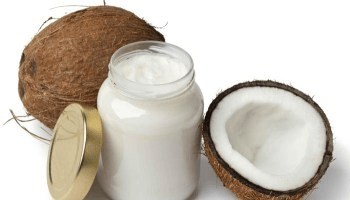
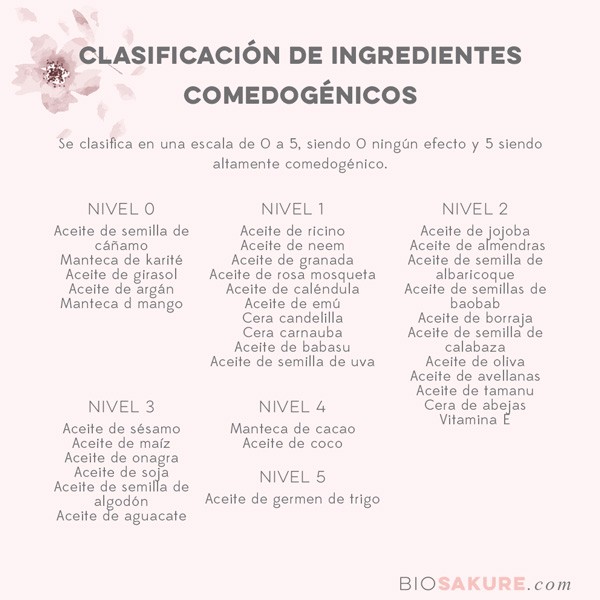
Regarding the oil to use, I use the argan oil because it is not comedogenic and it is the one which bottle I have now opened. When it is used up, I will use one of jojoba oil that I have unopened. Many also use olive oil, coconut oil…It all depends on whether you have oily or acne-prone skin, in that case you should look for non-comedogenic oil. If you don’t have this problem, any oil will work.. Anyway, as you rinse and wash your face with soap afterwards, it is difficult for oil to clog pores on the skin, it is not the same as using it as a moisturizer. Rather, what is sought with this method is: 1) a good cleaning, 2) avoid drying the skin when applying the soap or cleanser (since the oil creates a protective film on the skin). There are people who even apply oil to the body before showering so that their skin does not dry out with the lime from the water or due to  soap, and the same to the scalp before washing their hair (I also do this, with coconut oil, and my head no longer itches, which sometimes happened to me before). Having a limescale/chlorine filter in the shower also helps with skin and itchiness.

That’s it for today, until next time!

*To buy the products I speak about (I only recommend products that I’ve tested):

As an Amazon Associate I earn from qualifying purchases

*From the United States:

*From Mexico:

*From Spain:

Don’t buy aloe vera, have an aloe vera plant!!

Hello!!

In this month’s post I’m going to talk about my new discovery for (facial) skin care. Well it’s not really a discovery because I have been using aloe vera on my face for many years, but now I have switched to real pure aloe vera, straight from the plant. A few years ago, my mother bought an aloe vera plant and we had it on the windowsill in the bathroom. I tried to cut a stalk (leaf) and put the gel on, what was left over we kept in a glass in the fridge. The problem with this method is that there is a lot of gel left over and the gel spoils in a couple of days, even if it is in the fridge. That is why commercial gels, no matter how organic and pure they may be, carry some preservatives (like all cosmetics). Not that this is wrong, but of course I think that if aloe is only aloe, then much better.

That plant died and I did not try the natural method again. Also of course it is much more practical to have the aloe in a container that you take anywhere, put it on and that’s it. For years I used one from the Canary Islands that had very few ingredients, it was called Aloveria. I liked it a lot but they stopped selling it in El Corte Inglés and I didn’t want to spend more to buy it directly from the company, because of the shipping costs. With that and with the proliferation of eco stores and online commerce, I began to buy other brands of aloe on the Internet. I didn’t like them as much as Aloveria but they were organic brands, with pure aloe as the first ingredient, and they were cheap. My skin always felt somehow tight when I put aloe on, I thought it was normal because I had read that aloe, although it hydrates a lot, creates an effect like when you put a facial mask on the skin and it dries. What started to bother me is when I noticed that my skin was peeling a little. This happened with an Italian brand of aloe that I bought online and … surprise! Looking carefully at the ingredients list, I saw that it contained alcohol. I could not believe that I, who supposedly already knew all the tricks of the cosmetic industry, had fallen into that error. All for believing that since it was sold in an organic store it would be very pure and such. So I switched to another (made sure it didn’t have alcohol or too many ingredients). But I was wrong again. It turns out that one day reading a blog I found that now there are pages so that one can see what are the ingredients in cosmetics, for all the controversy that has been going on about lead on lipsticks, carcinogenic ingredients and endocrine disruptors etc. The page that I used is called cosdna.com. I put the ingredients in my new aloe vera gel and it turned out that it contained polymers (a petroleum derivative) and sodium hydroxide. I already talked about sodium hydroxide in another post. It is an irritating and very drying ingredient. Although it is widely used in natural cosmetics, especially to make soaps and shampoos, I think a soap that you rinse is not the same as a gel you put on your skin to absorb it. After investigating I saw that it is precisely something that irritates the skin of many people. So that encouraged me to try the natural method again.

I bought an aloe vera plant for 4 euros in a greenhouse, with its pot included. The aloe vera plant is very easy to care for, you only need to water it once a week and keep it at a warm temperature, tending to hot (between 15-25 degrees). In winter it can simply be kept indoors in an illuminated place, and in summer on a window ledge. It is not recommended to leave aloe in direct sunlight (at least not all day), so that the leaves do not get “burn”.

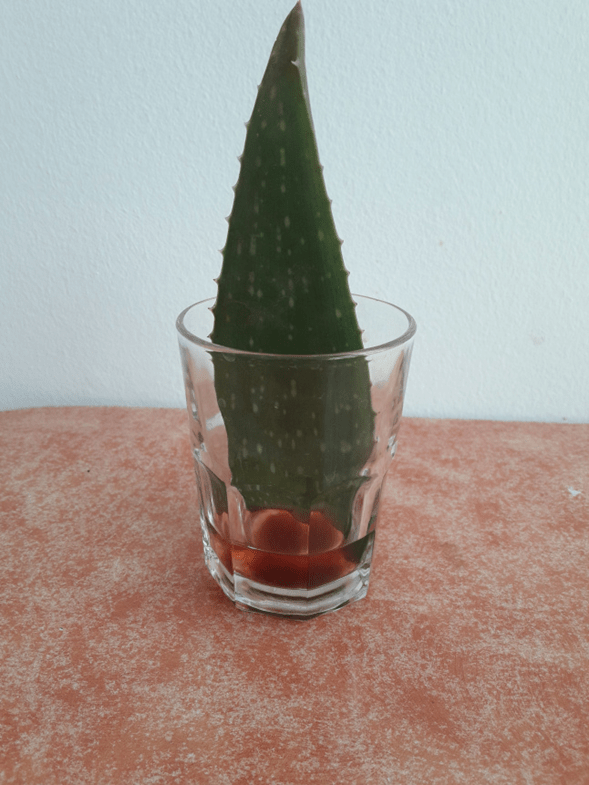
To use aloe vera, what you do is to cut a stalk that is on the outside. That stalk will then grow on its own. You clean any mud and put in a glass with some water on the part where the aloe gel is visible. This is to release the aloin, a kind of iodine that the plant has and that can be irritating. I left the leaf 24 hours and this was the water’s appearance:

The next step is to peel the leaf, making two cuts on the sides and opening it. The gel is removed and, at this time, what can be done is to put it directly in an ice bucket or to liquefy it with a hand rod mixer (and then you distribute the liquid aloe in the ice bucket)(don’t use any water!). If you choose the liquefy method, aloe vera lasts more, since you’re using all the aloe. If you don’t liquefy it you’re just using the liquid on the surface of the aloe pulp. Besides, if you don’t liquefy it, take into account that the aloe vera pulp is a bit messy to handle, it feels like snail drool.

Once the aloe pulp or liquid has been distributed in the ice bucket, it is put in the freezer and in a few hours the aloe cubes can be removed into a Ziploc bag. What I do is to take an ice cube out and put it in a small glass (one of those for shots) and I leave the small glass in the fridge. There the ice cube thaws, and I already have a dose of cold aloe vera, which lasts for about two or three days in pulp, and more if it was previously liquefied. I apply it twice a day, morning and night).

What I have noticed with this new method is that my skin is no longer dry, tight or peeling. You only notice some tightness in the first seconds of putting it on. It seems wonderful to me and it does not involve so much work, in addition to being cheaper than buying commercial aloe gel. The only difficulty I see is when it comes to traveling, for trips of more than 3 days and without access to a refrigerator. If not, just pop a cube or two in an empty cream container and you’re done.

I hope you like this information !! Until the next post!

*To buy the products I speak about (I only recommend products that I’ve tested):

As an Amazon Associate I earn from qualifying purchases

*From Spain:

A small summary

Hello everyone!!

This month’s post is going to be a compilation of everything I’ve been writing about on the blog, since I started with three posts in 2015, until I decided to take it more seriously and write a monthly post as part of my goals for the year in 2017.

When I started the blog I wanted to share things that I had discovered by myself, especially through the Internet and from my own experience and that of others, over the years. They were doubts, questions that do not appear so much in beauty magazines and on blogs and YouTube channels, or that in the case of appearing I considered they had wrong or incomplete answers (such as taking the pill if you have acne or resorting to laser if you have hair on your face…). I really wanted to address problems and solutions that I thought were not being publicized enough.

In 2015 I explained how the irrigator (in its eco-friendly and cheap version, the Italian So-Wash) is the secret weapon that dentists do not want you to discover, along with the coconut oil + bicarbonate toothpaste. A toothpaste that also works as a deodorant. I also published the most visited and consulted entry of the entire blog, the one that talks about electrolysis hair removal. A post that I updated later showing the progress of my “do it yourself” results in this regard.

In 2017, I started talking about my experience with hirsutism and acne, I defended Roacutan and Ovusitol against the contraceptive pill and I talked about some simple and cheap measures like aloe vera, castile soap (Dr. Bronners), the importance of changing face towels and the pillowcase (better if it is made of silk) often. I have also talked about the importance of nutrition (the now fashionable smoothies) for the skin and the little-known mineral makeup.

Also in 2017 I dared to confess the existence of tonsil stones and anal blackheads, in the most eschatological blog post. I spoke again about hair, but this time about hair on the head: I was interested in henna as an alternative to dyes and allergies, but I was worried that it would not cover gray hair well.

I also talked about health issues, such as period pain, and how I try to control them by always keeping omeprazole and ibuprofen close at hand, in my emergency bag. Or the problem of belonephobia, so poorly treated by most health professionals and which causes serious trauma to many people. I still hadn’t found a definitive solution to this issue, but reading the book Overcoming Medical Phobias gave me some hope. Trying psychological treatments (hypnosis, neurolinguistic programming) gradual exposure (with images, videos…) and using the applied tension of the muscles could be the key. In my case, I also think that choosing a different site from which to draw the blood (perhaps the hand and not the inside of the elbow) could have an influence. I’ve been working on this for the past few months, and I’ve gone from feeling a bit dizzy just reading or watching videos about it, to being able to tolerate it (at least from a distance). I also think that the time of day influences, since for example I have the lowest blood pressure and I am weaker in the morning, which is precisely when the blood extraction procedure is done (and on an empty stomach). A reader advised me to use Buzzy and I have it ready to try in the future. What I’d really like to try though is the Seventh Sense Biosystems TAP. I keep writing them to see how to acquire it but it seems that at the moment only certain laboratories have it (I have also written to them and they do not respond). I hope it is only a matter of time, because it gives me the impression that there may be the solution. Other alternatives are the use of Vacutainer or butterfly needles for extractions. I had considered these alternatives, so I would also like to try. Anyway, hopefully in the future I can write a post explaining how I finally solved the issue. It would be my personal big hit on these issues, along with the discovery of electrolysis :))

In the blog I have also shared my personal manias, such as my rejection to long nails (which does not mean that I do not take care of my hands), my rejection of feet, of absurd fashion stupidities like ripped pants, my horror of intestinal parasites and of noise. And I have defended the use of the forgotten bidet, protection from the sun but not with creams, internal and external hydration and attention to the lymphatic system.

Some posts include novel therapies, such as the natural solution to myopia (including much cheaper glasses), a problem that I had previously discussed. In this regard, I recently read a piece of news about some drops to solve myopia developed by a university in Israel … I’ll be watching too. Hopefully ending myopia without surgery will my third hit :))

*To buy the products I speak about (I only recommend products that I’ve tested):

As an Amazon Associate I earn from qualifying purchases

*From the United States:

·Buzzy: https://amzn.to/2ZTLvDF

*From Mexico:

·Buzzy: https://www.buzzy.com.mx/

*From Spain:

·Buzzy: https://amzn.to/2RUnzMh

Hydration

I am going to dedicate my first post to hydration: inside and outside.

I think more attention is paid to external hydration than to internal. I was recently on a trip with a friend, and I observed that every day, before getting dressed, she put cream to hydrate her entire body and face. However, throughout the day, despite the hot weather, she hardly drank any water. Instead of water, she drank coffee and beer, depending on what time it was (both drinks dehydrates). And she was surprised that I always drank water with my meals.

Hydration, both internal and external, is very important, but I think internal hydration is more important than the external one. We are 70-80% water, and that water must be replaced throughout the day, especially if we are in a hot environment. If it is cold, it is normal that we are less thirsty, but we must drink the same (if we want hot drinks, we can do it in the form of tea or infusion) and our skin can look dry due to heating. If it is hot, we will naturally be thirstier, and if we sunbathe our skin will dry out more than if we are in the shade. In the case of children and the elderly, it is necessary to ensure that they drink water, especially the elderly, as they have a decreased sensation of thirst.

My trick to staying hydrated is to try to drink water every half hour (two sips). I drink water in the morning before breakfast (after rinsing my mouth with coconut oil), and at work. I have my water bottle (not plastic) to try to drink every half hour. Obviously if I’m on the street I can’t do this, but there is also the option of carrying a bottle of water in your bag. The green juices I have for dinner (two or three glasses) also hydrate. When you drink too much alcohol and coffee, or simply don’t drink enough water, it reflects on your energy and the condition of your skin.

Moving on to external hydration, I hydrate my face and neck in the morning and at night. I only use some good aloe vera (from my aloe vera plant), and lately, because I’m in my thirties, a little coconut oil at night, mainly in the eye and forehead area (I’m still scared that I get a grain for being oil, although not yet). I also hydrate my lips with coconut oil. And at night I put coconut oil on my hands, elbows, knees, and feet, before I go to sleep.

What I don’t normally do is hydrate my whole body. Why? Well, because it involves time and expenses on the product (even if it’s coconut oil) that I don’t want to assume. My face and hands are constantly exposed to the outside, so it makes sense to hydrate them daily. Elbows, knees and feet require very little amounts, and I hydrate them daily to prevent callus. But for the body, which is normally covered and only gets soaked briefly in the shower, I don’t see the need to use moisturizer (I don’t rub soap all over my body every day, just occasionally; I use soap only in private parts and armpits).

Of course, it would be another thing if, for example, I went swimming or to the beach to sunbathe, then I would hydrate my body too. But normally I don’t do that. And my skin is very soft (to a great extent thanks to the electrolysis hair removal). On TV and in pharmacies they sell us the idea that it is necessary to smear ourselves with creams every day (tonics, nutritive creams, eye contours, bla, bla, bla). Well look, it is not like that, and I have verified it in myself (in addition, creams are usually made of petroleum derivatives that seal the skin like a plastic). With a few products (aloe vera, coconut oil) normally applied only to the face, neck, hands and troubled areas, it is enough. And when the age is really noticeable (which will be less if the sun does not shine on our faces) it is better to go once or twice a year to one of those places that inject vitamins and all that stuff on your face, than to spend that money on creams. Anyway, I hope in my case that will be, at the earliest, at 40.

So, in conclusion, more internal hydration and fewer complications with the external one.

Until next time! 🙂

*To buy the products I speak about (I only recommend products that I’ve tested):

As an Amazon Associate I earn from qualifying purchases

*From the United States:

*From Mexico:

*From Spain: