Make the most of your solid shampoo (or any bar soap) with a stocking.

Sure! Here’s the full translation of your blog post into English:


Hello everyone!

It’s been a very long time since I last wrote on the blog, but here I am again to share interesting and useful things. This is my latest discovery and, even though it’s a small thing, I’m really excited about it because I had never thought of it before.

I’ve been using solid shampoo for quite a while now because it’s more eco-friendly, practical for travel, and supposedly cheaper, since you’re not paying for a bottle filled with water and a bit of product (as you do with liquid shampoo). You’re paying only for the raw material — the shampoo itself. I say supposedly cheaper because the problem I was having is that when the bar was quite worn down, it was hard to use — not enough lather came out, it would slip from my hands…

I did some research online and found recipes where people cut up the leftover bits of shampoo (or soap), dissolve them in hot water, and make a liquid shampoo. There are also videos where people turn soap flakes into a new bar. I tried the first idea, but it didn’t work — the pieces didn’t dissolve well. Besides, if you do that, it would only be for one-time use, since you’re mixing the product with water and not adding any preservatives like commercial liquid shampoos do. I didn’t try making a new bar, but to do that you need to have enough leftover bits.

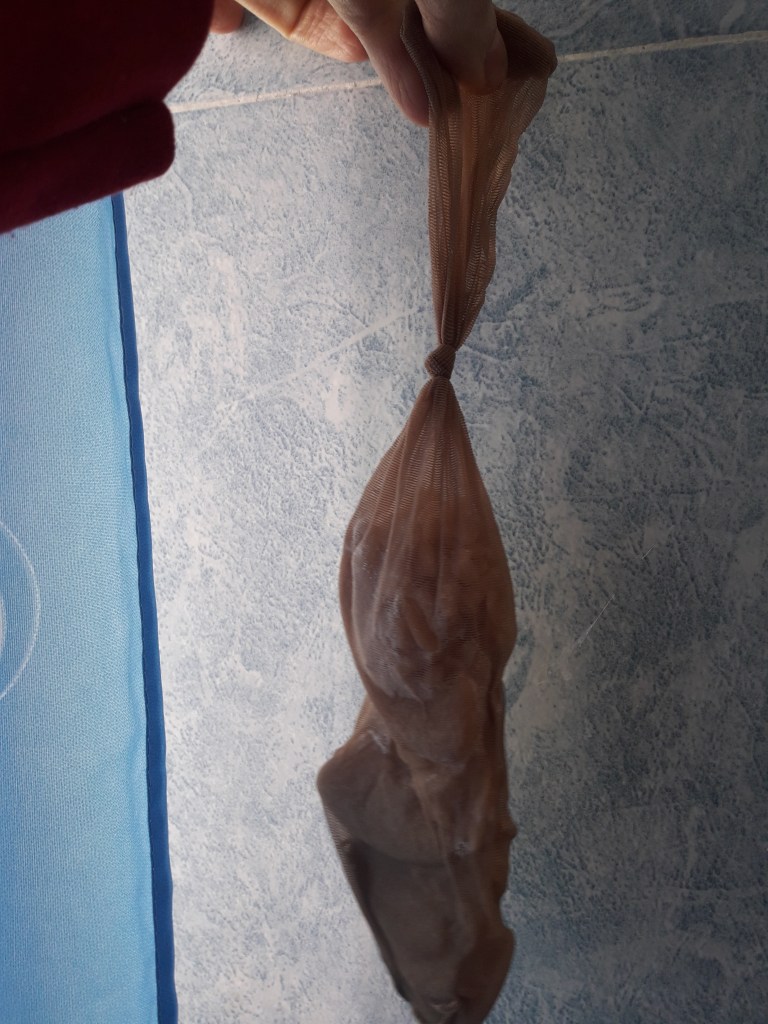
Anyway, the other day I came across a video where a woman said they used to wrap the soap bar (for body use, in this case) in one of those fabric sponges. And that’s when the lightbulb went on! I remembered other videos explaining how you could use an old mesh or stocking to strain nuts for making plant-based milk. And I thought — what if I put the solid shampoo in a stocking to “squeeze” every last bit out of it? Said and done! I cut up an old stocking, put the solid shampoo pieces inside, and tied a knot. When I washed my hair, it worked perfectly — not a single bit of shampoo slipped away, and once mixed with water and rubbed onto the scalp, plenty of lather came out. That way you can use up every last flake. Then you just leave it to dry, and that’s it. When the stocking wears out, you can just wash it normally and use it again. I’m adding a photo of my shampoo-in-a-stocking, already used.

Hope this helps you all! 🙂

Intimate Grooming

Hello! Happy 2021! In the first post of this year I’m going to talk about some grooming issues that I think don’t appear very much on the Internet.

The first one are inverted nipples. What?? Yes, there are women (including myself) whose nipples are not erected, or not always. This is called having flat or inverted nipples. In my case, they are usually flat, but with cold or when touched the “tip” comes out. They’re shy, hahaha. For me it is not too much of a problem, quite the opposite, since I do not have that problem of the noticeable nipple when wearing a sports bra or not wearing a bra. Something that, by the way, should not be a problem either, since a nipple is normal, well, what if it is noticeable under the clothes? Men’s package is usually noticeable too. One day I heard a youtuber telling that she had inverted nipples, and that since she wanted to have a baby, she needed to have a surgery there before, in order to be able to breastfeed her baby. When I had rhinoplasty this summer, I mentioned this to the surgeon and he told me that it is just the opposite: if you have inverted nipples and you have surgery done there, you can no longer breastfeed. So, I have doubts about it, if someone has had this problem and has had surgery and then breastfed, please tell me. I read that having flat or inverted nipples may cause problems when breastfeeding, but in my case, since by just touching them they come out I do not think so. What the surgeon told me is that with the surgery to pull the nipple outwards, some “fibers” are cut (those “fibers” cause the nipple go inwards) and that is why afterwards it is no longer possible to breastfeed. Whatever.

Another issue I wanted to discuss is the pubis/labia majora. I think that in a post I already mentioned that I had full intimate hair removal for the first time two years ago, and now I have completely finished the process. There is no going back. I thought a lot about whether I should do it or not, because with electrolysis hair removal the result is definitive. As it was not my priority, I left it until the end, but now after three sessions I am already hairfree there. My doubts were whether I looked or felt strange, and because hair is supposed to have a function there, to protect from friction and against some sexually transmitted diseases.

Well, I did not take my decision for sexual reasons because I am not promiscuous nor did I seek to improve sensations or something like that. I did it, honestly (and I know I’m not the only one who thinks so) because I was sick of seeing pubic hairs (even tough they were mine!) On the bathroom floor, in the sanitary towels, in my pants, on the shower floor… Like the hair on the head, pubic hairs are renewed and fall out, and are long enough to be seen. I don’t go naked at home, so I could not understand how I could see pubic hair on the bathroom floor, just due to drying off after showering. The fact is that I was very disgusted. And those hairs were quite dark, curly and long, gross. Another reason for me was the odor/hygiene issue. Although hair is not synonymous with dirt, well, some remains keep there when you urinate or have your period. Finally, I had a stain on my groin that I thought was from when I had laser there many years ago. I thought it was a burn and that’s why I had that brown stain. But one day it started to itch, and then I started to wonder if it was a fungus. And yes, it turns out that I had a fungus in my groin for several years and had not found out. With a cream it was removed, but I did not stop thinking about how a fungus could have come out there. Because of my lifestyle it was not possible that it was due to something contagious. Then I realized: fungi come out because of the humidity. What could have caused humidity there? Well, when I shower, I usually dress immediately, and my public hair was still half damp when I put my panties on. That’s why the fungus started. I searched on the Internet and saw that other people had also suffered this problem, and they recommended drying public hair with cold air with the hairdryer, or intimate epilation. For the reasons stated above, I preferred the second option.

And that is how I decided to have a total intimate epilation. I forgot to mention that, with aging, many women get gray and bald spots there, so that would be one less inconvenience. With intimate hair removal I have included the pubis and the entire intergluteal/perianal area. It feels very clean in the shower when you notice that there is no hair there. It also feels less annoying with the period, and I don’t get any hairs stuck to the glue of the sanitary towel (it used to be a sudden pain when going to the bathroom hahaha) I was worried that I would notice more friction, for example, when riding a bike. But no problem. Since the epilation was with local anesthesia, it was not painful at all, nor did it give me any problems afterwards, the area swells a little and then it goes down.

One last topic that I have learned about is related to the labia majora. I really don’t know how the “intimate area” of other women look like. But it seems that, as with breasts, there are differences, there are women with larger or smaller, darker or lighter labia majora. In the intimate area the skin is darker than in the rest of the body, that is clear. And it seems that some people whiten that area. Some women have their labia majora too big, or one bigger than the other, and it seems to them little aesthetic or it bothers them with tight clothes. I have one labia majora larger than the other and somewhat dark, but it doesn’t give me any comfort problem or anything. In fact, bigger labia majora are supposedly beneficial on the sexual area. Anyway, for those who may be concerned about this, there is also an intervention that “cuts” labia majora (with laser) and makes them look more aesthetic.

Well, you see, I always talk about “never said” issues. In addition to being curious, they seem to me to be issues that must also be discussed, otherwise it happens as it happened to me with my hair problem: it happens to a young or  uninformed girl and she thinks that she is abnormal and that it only happens to her to her. All because some issues are not discussed.

Until next post!

I wrote a book!!

In the last post of this strange year 2020 I want to share that I have written a book!! It is not my first book, but it is the first that I did not write for work reasons and that I’m publishing as Mariahelpsyou. It is available in Spanish and English, both in ebook and paper format. For every taste!

The possibility of self-publishing for free with Amazon had caught my attention a long time ago. Knowing the difficulties of gaining a foothold in the publishing world, it seems like a great option for all those who want to publish something that may not sell, or who are not professional writers. Taking advantage of the low social life imposed this year, I took on the task of compiling some of the blog posts into a book, which has the same title as the blog. It is a short book, with eight chapters, with the posts I thought were the most important to include. In the five years that have passed since I started writing the blog I discovered new things and I had to update several posts. So, in the book I wanted to include all that information together. For example, how I progressed with electrolysis hair removal, belonephobia, skin care, in dyeing my gray hair, in oral care…

The book is aimed especially at teenage girls and girls in their twenties. Every time I wrote a blog post, I mentally relived my past dealing with different beauty / health issues, and each time I thought: “If someone had told me this at the time.” I remembered how I felt so lonely and hopeless with certain problems, which apparently only happened to me because nobody around was talking about them, and that despite my many attempts seemed to have no solution. Some of them (like acne or gingivitis) may seem more common and not as serious. Others, like hirsutism or belonephobia, have really embittered much of my life. That is why the book is aimed at young girls who may living a similar situation. Although it has taken many years, I have found a solution to all these problems. And it has not been thanks to the many specialist doctors, or dentists, or hairdressers, or any so-called “professionals”, but only with my persistence and research on the Internet, losing a lot of time and money along the way. Whoever seeks finds (even if it is later than sooner). Although the book is aimed at young girls, of course anyone can benefit from reading it, at least one chapter, be it a man or a woman of any age.

And well, what better date to launch a book than before Christmas! I do not expect to earn lot of money with this, it would be enough for me to know that the knowledge I share arrived and helped someone who needed it.

Merry Christmas!!

*Where to buy the book:

As an Amazon associate I earn from qualifying purchases.

*Book in English: https://amzn.to/3fNCJxK

*Book in Spanish: https://amzn.to/33tbuUd

Double cleaning: oil+soap

Hello everyone!!

In this post I am going to talk about a new method that I have been using to cleanse my face. This added to applying only pure aloe vera gel (extracted by me from the plant, as I mentioned in this post) is working very well for my skin.

First of all, I know that what I am going to explain is something similar to the Korean double cleansing ritual. But since I have adapted it in my own way, I have not called it that. Official Korean cleanse includes wiping off the oil with a hot towel and I don’t do that. As always, I seek maximum efficiency with minimum effort, the famous Pareto law. And since I am already using one side of a facial towel (small towel that is only for my face) every night, that’s one facial towel that waits for the washing machine every other night, so I don’t want to also use even more towels to remove the oil from my face.

What I do every night is, always after washing my hands, put 5-8 drops of argan oil on my hands and rub it all over my face, massaging well, insisting where my skin is more greasy (forehead, nose, chin). Oil cleansing is also great for removing makeup, but I don’t normally wear makeup. Then I rinse my face with warm water and apply a few drops of Dr. Bronner’s soap. It is not a soap that dries out the skin because it contains all natural ingredients, although I know that there are people who simply wash with their face with oil and that’s it. But I also like to put a little of this soap. Then I rinse, already with cold water, and gently dry my face with the facial towel. And then I put some cool aloe vera that I have in a glass in the fridge.

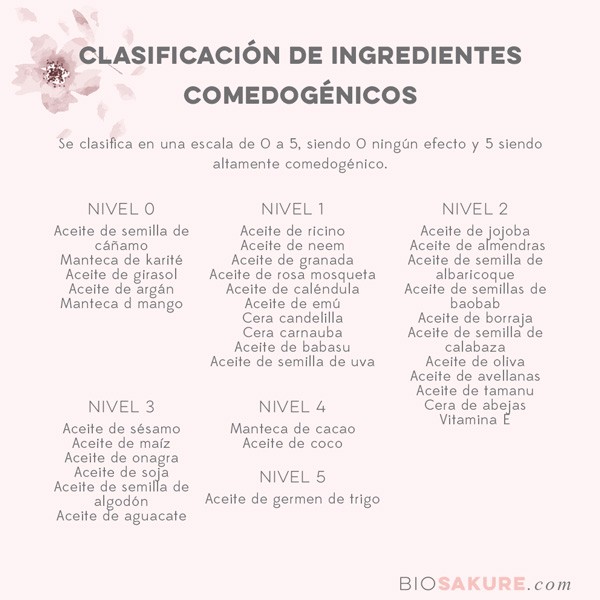
Regarding the oil to use, I use the argan oil because it is not comedogenic and it is the one which bottle I have now opened. When it is used up, I will use one of jojoba oil that I have unopened. Many also use olive oil, coconut oil…It all depends on whether you have oily or acne-prone skin, in that case you should look for non-comedogenic oil. If you don’t have this problem, any oil will work.. Anyway, as you rinse and wash your face with soap afterwards, it is difficult for oil to clog pores on the skin, it is not the same as using it as a moisturizer. Rather, what is sought with this method is: 1) a good cleaning, 2) avoid drying the skin when applying the soap or cleanser (since the oil creates a protective film on the skin). There are people who even apply oil to the body before showering so that their skin does not dry out with the lime from the water or due to  soap, and the same to the scalp before washing their hair (I also do this, with coconut oil, and my head no longer itches, which sometimes happened to me before). Having a limescale/chlorine filter in the shower also helps with skin and itchiness.

That’s it for today, until next time!

*To buy the products I speak about (I only recommend products that I’ve tested):

As an Amazon Associate I earn from qualifying purchases

*From the United States:

*From Mexico:

*From Spain:
Shampoos, hairbrushes and showers

Hello everyone!!

In this month’s post I will continue along the same lines as the previous one, talking about hair discoveries. Given my intention to reduce industrial cosmetics to the maximum or eliminate them completely (news about toxic ingredients in lipstick are nothing new) and my success in covering gray hair with henna, is no wonder I’m not satisfied with just using any supermarket shampoo/conditioner/mask products. Also, since I like to be as minimalist as possible, I have been searching for the simplest formula for months.

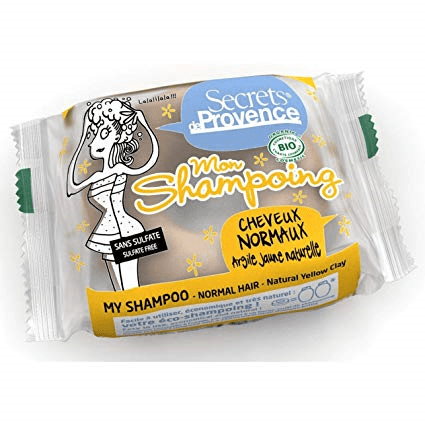
Well, I had heard about solid shampoos and about how convenient they are when travelling, but I had not tried them. For a long time I used the traditional yellow Johnson & Johnson (baby shampoo), because shampoos for babies’ ingredients contain less “shit” (although there have also been alarms for toxic ingredients in this type of shampoo). So, I started to look at solid shampoos and I think I have found the one that suits me very well, lasts a long time (another advantage of solid shampoos is that, since they are not diluted in water, they yield more) and it is decently priced for its duration. The shampoo I like is this one:

I also bought the container to put the donut-shape shampoo, and in the shower I simply leave it resting on the soap holder, because the hook that came with the shampoo doesn’t work. The ingredients of this shampoo are:

This shampoo also has versions for greasy, colored, children hair… but its composition does not vary much. I had tried another one that contained the typical caustic soda/sodium hydroxide that grandmothers’ shampoos/soaps used to have and that is still used a lot for homemade cosmetics today, but with that ingredient my hair looked too dull. As I dye my hair with henna, it is normal for my hair to get a little dull in the first wash after dyeing because there is still some mud residue, but by the second wash it is already perfect. And what I do after washing my hair and having it with a towel for 5 minutes is to spray it with white vinegar. Vinegar works as a conditioner for your hair (and for clothes in the washing machine, as well as cleaning the whole house along with baking soda). I use regular white vinegar because it is much cheaper than apple vinegar, and the effect is the same. Don’t worry about the smell because it goes away when your hair dries. And that is all, my friends! Henna, solid shampoo bar and vinegar, the 3 products I use for hair. Very cheap, ecological and non-toxic.

I am not going to dwell too much on the dangers of industrial shampoos, as there are already thousands of articles and blog entries that explain the harmfulness of parabens (endocrine disruptors), silicones (they damage hair) and sulfates (they cause dye to last less and they spoil hair). In addition to that, with industrial shampoos hair lasts clean much less time. The transition from industrial shampoos to natural shampoos can be a bit difficult (we seem to be doing better with industrial shampoos), but it takes a few washes. I do not usually use hair masks, but if I want to use it, I would simply put coconut oil before washing my hair and that’s it. And aloe vera gel works very well as hair gel, although I don’t use it either.

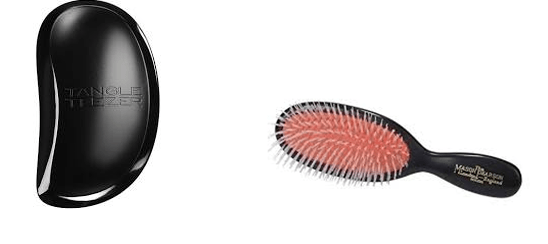
My hair is thick and strong, and although it may seem like an advantage, it is also complicated to deal with. Except when I straighten it, I do not brush my hair every day, only when I’m going to brush it (that is, every 4 or 5 days). And  I need a good detangling hairbrush, especially after applying henna. I have looked for hairbrushes that would help me detangle my hair easily, and the two best I have found are these:

The Tangle Teezer hairbrush detangles very well and is made of plastic, so it is easy to clean in the dishwasher. It detangles very well, you can use it also in the shower with your conditioner (or vinegar). I also bought the Mason Pearson hairbrush because I saw a Victoria’s Secret model recommending it 😊. It has surprised me because it is indeed very good. Since I already had the Tangle Teezer, I bought it in the bag version to carry in my bag (it’s cheaper that way) and I love it. I have it in blue and with nylon bristles (white ones, for thick hair). If your hair is medium (neither very thick nor very fine) there is a version with nylon and boar bristles, and if your hair is very fine with only boar bristles (the dark ones). I already had a boar bristle wood hairbrush, so I bought the nylon one.

For frizz (it happens in humid places and after drying my hair) I sometimes use a wooden comb. It is also good to roll your hair with a microfiber towel or a cotton shirt Anyway, the best thing for frizz is to iron your hair a little.

Finally, speaking of showering, I wanted to take the opportunity to point out that it is not necessary to lather the whole body every time we shower, and less with industrial soaps, because it causes too much dryness. I use the same soap for my body as for the face (Dr.Bronner’s) or a baby one (Mustela). I only use soap daily for my private parts armpits and feet. For the rest of the body, soaping it once a week is more than enough. This way the skin does not dry out so much and you do not need moisturizer after the shower. By the way, the best body creams, in my opinion, are coconut oil and shea butter.

Until next month!!

*To buy the products I speak about (I only recommend products that I’ve tested):

As an Amazon Associate I earn from qualifying purchases

*From the United States:

*From Mexico:

*From Spain:
I dye my hair with henna

In a previous post I already talked about my interest in henna. Since I started to have some gray hair (around 28-30 years old) I tried to use a natural dye, that would not complicate my life too much and in my own color. As I had heard ugly stories (from people I know closely) about serious allergies, damaged hair, sick people who are forbidden to dye their hair… I decided I would use only vegetable dyes. I tried the Apivita and Herbalife ones in dark brown, and they worked quite well. But the truth is that they are expensive (even if I only use half a box per month) and although they are softer than the usual supermarket dye, they as well contain an equivalent to hydrogen peroxide and chemicals that I do not like at all. I didn’t want to spend too much money in dyes at the hairdresser (stop thefts!). Also, several people had already told me about henna and I wanted to try it. The problem is that in all the research I did on the internet it appeared that it is not effective in covering gray hair, and that it stained everything, so that discouraged me a lot. But I decided to try after talking to someone who assured me that it does cover gray hair.

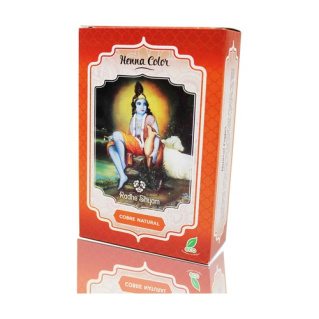
Since I wanted a color similar color to mine (dark brown), I bought Radhe Shyam’s Indigo Henna Mix (specifically the deep brown color). Actually, the mix has more indigo than henna (the order of ingredients in the products goes from most to least, this also works for food ingredients). Indigo is the blue dye used to dye jeans, and just like jeans, it fades with washes. Mixing indigo with henna brings out the dark color. In fact, there are people who only use indigo to dye their hair black. The world of henna includes mixtures with plants to achieve different colors, shine… But what really covers gray hair is henna, which gives a reddish color to gray hair and blends with the natural hair color.

My experience with the indigo + henna mixture was not good. And I gave it several opportunities (about 4 or 5 applications) testing the application in different ways. To begin with, the indigo left black stains on my towel, collar, nails, hairbrush … a disaster. And I did not feel that the gray was covered well (indeed, the component that dyes gray hair is henna, and it comes in less quantity than indigo in the deep brown color). In addition, as I investigated later, the two plants have different ways of working: for henna you have to mix with water at a higher temperature and the indigo with less, the acid (for example from vinegar) that makes henna work better inhibits the indigo color… a mess, too complicated. In fact, they recommend that you dye first with henna alone to cover the gray hair and then with indigo to achieve the dark color. Just the complications that I don’t want.

So I decided to try henna alone. I was worried that the result would be weird as I have dark hair and gray hairs would be red. But hey, I don’t have that many either so it couldn’t be so horrible. I found a book called Henna for Hair. How-To Henna, by Catherine Cartwright-Jones, year 2006. Apparently it is the result of a doctoral thesis on henna. You can find it for free on the hennaforhair.com page. On this page they explain many things about henna, and the book is very interesting, it contains historical and practical information. In the book they explain how, experimenting with dyes in sheep’s wool, they saw that the color was much better mixing the henna with acid, and not with water (doesn’t matter temperature) as they usually recommend in the manufacturers’ instructions (in fact, another very famous and more expensive brand than Radhe Shyam, even though their dyes contain the same ingredients, is Khadi, who even sells you a thermometer to check that you have the perfect temperature for henna, purely to create unnecessary purchases). So, I started using the henna alone, preparing it the night before with white vinegar, and heating the mixture in double-boiler the next morning. And boy did it work. The gray hair was covered perfectly, and it does not look strange with my color, it looks like highlights. In the rest of the hair, you hardly notice anything, maybe some red highlights in the sun. This is perhaps because my hair is very thick and does not hold the color as much, but I repeat that gray hair is perfectly covered and it does not go away. In fact, I see perfectly when I need to dye again because my hair has grown, but the gray that is already dyed keeps red.

Another hotly debated issue is the issue of application. On the page and book that I have recommended they say that henna must be applied with clean hair, not so much because it cannot be applied with dirty hair but because they tell you that after the application (in my case I leave it 4 hours but a lot people have results in less time, although less than 2 hours would not be recommended) henna should only be rinsed with water, without shampoo. Then you should allow two or three days for the henna to release all the pigment in your hair when oxidizing, and then wash the hair. I did it like this the first few times, but it was very difficult for me to spend 3 days with traces of mud in my hair, which although they were not noticeable, left my hair very dull. In addition, this procedure involved washing my hair, then applying the henna (I tried both dry and wet) and then rinsing it in the shower. I wash my hair every 4-5 days, I have a lot of hair and it takes time to dry even with a hairdryer, so this process was too cumbersome and time-consuming. So, I tried applying it like regular dyes (on dirty hair and shampooing after application) and voilà, it worked just as well. So one less complication. In short, now the only different thing that henna implies compared to a normal dye is the time that I leave it on. Yes, it is more messy to apply, but a friend from work comes over and puts it on me in no time. Update: Iater I also learn to apply it myself. 😊

So I am very happy with the results of the henna. First, it’s very cheap: less than 3 euros for a box of Radhe Shyam that currently serves me for two applications, I buy the color “natural copper”, which is the one that contains only henna. Do not get confused with other brands that come from India, if you are in Spain, this brand is cheap, has been around for many years and has the eco certification. I cannot opine about the efficacy and ingredients of other colors, but for pure henna I would choose Radhe Shyam. Second, after about eight attempts, I finally discovered the most efficient/least cumbersome/least time-consuming way to apply it: mix with vinegar the night before, apply on dirty hair the next morning, leave it 4 hours and wash afterwards. I don’t know why people get so complicated, or maybe it’s a matter of what works for some and for others. On the mentioned page and on forums they recommend not using sulfate shampoos because it would damage the color, although I don’t think it’s that bad either. I will talk about sulfate-free, solid shampoos and other hair discoveries in the next post. Well, from the photos I have seen, it seems that brown/fine hairs get very caught by the red/copper tone, it is very beautiful. Not for me, as I said I just have some red highlights. The gray hairs are orange/reddish but with the days they blend more with the hair color.

Henna does not stain anywhere near as the mixture I used of indigo + henna, but in my case it does leave some smears on the hairbrush. Not so on clothes, sheets or pillow. In any case, some mud that may take a few washes to completely go away (but you can’t see anything in the hair, it looks completely clean) can help those with oily hair to space out washes. I don’t have greasy hair, but I don’t feel that henna has dried it out. In fact, henna in addition to dyeing is supposed to nourish and make hair thicker (I didn’t need more of this, but anyway).

I will continue with hair news 😊

*To buy the products I speak about (I only recommend products that I’ve tested):

As an Amazon Associate I earn from qualifying purchases

*From the United States:

*From Mexico:

*From Spain:
A small summary

Hello everyone!!

This month’s post is going to be a compilation of everything I’ve been writing about on the blog, since I started with three posts in 2015, until I decided to take it more seriously and write a monthly post as part of my goals for the year in 2017.

When I started the blog I wanted to share things that I had discovered by myself, especially through the Internet and from my own experience and that of others, over the years. They were doubts, questions that do not appear so much in beauty magazines and on blogs and YouTube channels, or that in the case of appearing I considered they had wrong or incomplete answers (such as taking the pill if you have acne or resorting to laser if you have hair on your face…). I really wanted to address problems and solutions that I thought were not being publicized enough.

In 2015 I explained how the irrigator (in its eco-friendly and cheap version, the Italian So-Wash) is the secret weapon that dentists do not want you to discover, along with the coconut oil + bicarbonate toothpaste. A toothpaste that also works as a deodorant. I also published the most visited and consulted entry of the entire blog, the one that talks about electrolysis hair removal. A post that I updated later showing the progress of my “do it yourself” results in this regard.

In 2017, I started talking about my experience with hirsutism and acne, I defended Roacutan and Ovusitol against the contraceptive pill and I talked about some simple and cheap measures like aloe vera, castile soap (Dr. Bronners), the importance of changing face towels and the pillowcase (better if it is made of silk) often. I have also talked about the importance of nutrition (the now fashionable smoothies) for the skin and the little-known mineral makeup.

Also in 2017 I dared to confess the existence of tonsil stones and anal blackheads, in the most eschatological blog post. I spoke again about hair, but this time about hair on the head: I was interested in henna as an alternative to dyes and allergies, but I was worried that it would not cover gray hair well.

I also talked about health issues, such as period pain, and how I try to control them by always keeping omeprazole and ibuprofen close at hand, in my emergency bag. Or the problem of belonephobia, so poorly treated by most health professionals and which causes serious trauma to many people. I still hadn’t found a definitive solution to this issue, but reading the book Overcoming Medical Phobias gave me some hope. Trying psychological treatments (hypnosis, neurolinguistic programming) gradual exposure (with images, videos…) and using the applied tension of the muscles could be the key. In my case, I also think that choosing a different site from which to draw the blood (perhaps the hand and not the inside of the elbow) could have an influence. I’ve been working on this for the past few months, and I’ve gone from feeling a bit dizzy just reading or watching videos about it, to being able to tolerate it (at least from a distance). I also think that the time of day influences, since for example I have the lowest blood pressure and I am weaker in the morning, which is precisely when the blood extraction procedure is done (and on an empty stomach). A reader advised me to use Buzzy and I have it ready to try in the future. What I’d really like to try though is the Seventh Sense Biosystems TAP. I keep writing them to see how to acquire it but it seems that at the moment only certain laboratories have it (I have also written to them and they do not respond). I hope it is only a matter of time, because it gives me the impression that there may be the solution. Other alternatives are the use of Vacutainer or butterfly needles for extractions. I had considered these alternatives, so I would also like to try. Anyway, hopefully in the future I can write a post explaining how I finally solved the issue. It would be my personal big hit on these issues, along with the discovery of electrolysis :))

In the blog I have also shared my personal manias, such as my rejection to long nails (which does not mean that I do not take care of my hands), my rejection of feet, of absurd fashion stupidities like ripped pants, my horror of intestinal parasites and of noise. And I have defended the use of the forgotten bidet, protection from the sun but not with creams, internal and external hydration and attention to the lymphatic system.

Some posts include novel therapies, such as the natural solution to myopia (including much cheaper glasses), a problem that I had previously discussed. In this regard, I recently read a piece of news about some drops to solve myopia developed by a university in Israel … I’ll be watching too. Hopefully ending myopia without surgery will my third hit :))

*To buy the products I speak about (I only recommend products that I’ve tested):

As an Amazon Associate I earn from qualifying purchases

*From the United States:

·Buzzy: https://amzn.to/2ZTLvDF

*From Mexico:

·Buzzy: https://www.buzzy.com.mx/

*From Spain:

·Buzzy: https://amzn.to/2RUnzMh

Silk pillowcases

Hello!!

In this month’s post I am going to talk about something that I think many people don’t know. At least I did not know it and when I found out about it it seemed very logical. This is a beauty hack that comes pays off over time. Let’s get to the point: rather, to the wrinkle.

For some time it has been circulating on the Internet that using silk pillowcases reduces the formation of wrinkles. Even at 33 years old wrinkles are not something that worries me too much, perhaps because of how long it took me to get out of the acne trauma. But I think it is time to pay a little attention to this issue. As I said in the post about the sun, for me the most important thing in terms of wrinkles is that the sun does not shine on your face. Like a geisha face. Not to mention the formation of spots, moles, etc. that one prevents. Another very important aspect is to drink water, not to smoke or drink alcohol, not to apply too much foundation because the skin does not breathe (sorry for those who cannot do without this, however, a good option is mineral makeup). I am not a fan of anti-wrinkle-anti-aging creams nor do I use them, I also said in another post that it seems more useful, when the time comes, to invest that money in going to a doctor and getting filled with vitamins-hyaluronic acid-collagen and so on, than go around testing unnatural creams.

But back to silk pillowcases. According to Dr. Google, it is an Asian (I think Chinese) beauty hack that has been used for centuries. The idea is that cotton is a moisture-wicking fabric: that’s why towels are made of cotton. So, if one spends 8 hours a day sleeping, all her life, with her face resting on a cotton pillowcase, what happens is that her skin loses water, becomes dehydrated, and that favors the appearance of wrinkles. In addition, having your face resting on the pillow causes it to “squeeze”, waking up with pillow marks on the face, and wrinkles form as well. And not only on the face but also, to those who have big breasts, in the neckline. Ideally, you should sleep on your back and not rest your face on either side. I’m trying to sleep on my back, but it seems a bit impossible. Does anyone sleep on their back? So, buying some silk covers (which because of the material are soft and do not “rub” against the skin or take away moisture) seemed much more feasible.

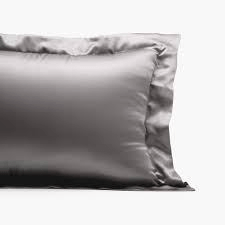
I started searching and it turns out that real silk pillowcase are quite expensive. Although they do seem like a good investment, because they can last you many years. But what I did was to buy some that, although they are called “Spasilk”,  are not made of silk. They are made of polyester. This fabric comes from oil and resists moisture, so is not recommended for shirts. Well, that’s supposed to be what we want for the face, that the pillowcase doesn’t absorb the moisture from our skin.

According to the Internet, silk pillowcases also help prevent hair from frizz and prevent acne. Regarding the latter, I have already explained that I use each pillowcase 4 times (one for each side, then I reverse it and use it other two times). I do this because my face and hair rest there each night, and they’re not always that clean.

Finally I bought a real silk pillowcase. Y already had the White Lotus silk sleeping mask. I only use it for naps, because where I live now they don’t know what blinds are and I like sleeping in darkness. This brand also has silk pillowcases.

Silk pillowcases, an Asian luxury

Until next post!!

*To buy the products I speak about (I only recommend products that I’ve tested):

As an Amazon Associate I earn from qualifying purchases

*From the United States:

*From Mexico:

*From Spain: