
Hello everyone!!
In February 2018 I wrote a post talking about what it means to be myopic (glasses, contact lenses, Lasik surgery…). Obviously, myopia and its incredible increase in the world population has a lot to do with the modern office/screen/smartphone lifestyle. In July 2018 I wrote a post explaining Jake Steiner’s anti-myopia method (which you can follow on YouTube and his website endmyopia.org). With only a few months applying this method (to the best of my possibilities) I already had a decrease of 0.25 in my myopia.
I think there is a lot of ignorance and conformity regarding myopia. Nobody stops to reflect on whether it is normal for their eyesight to worsen year after year, even when they are young, or whether it is normal to be prescribed more and more diopters each time they visit the optician, with the consequent change of glasses and financial outlay. Which by the way is an abuse, glasses are simply lens with an anti-reflective coat, and the profit that the opticians get for selling them, with respect to the cost of production, is insulting. Most 400 and 500 euros glasses should not cost more than 50, what people pay for is an enormous increase in the price of a few simple lenses and the brand of the frame. Glasses, more than an instrument to see better, seem to be traded as if they were luxury items, such as brand bags. I no longer buy glasses at an optical store but online with Zenni Optical.
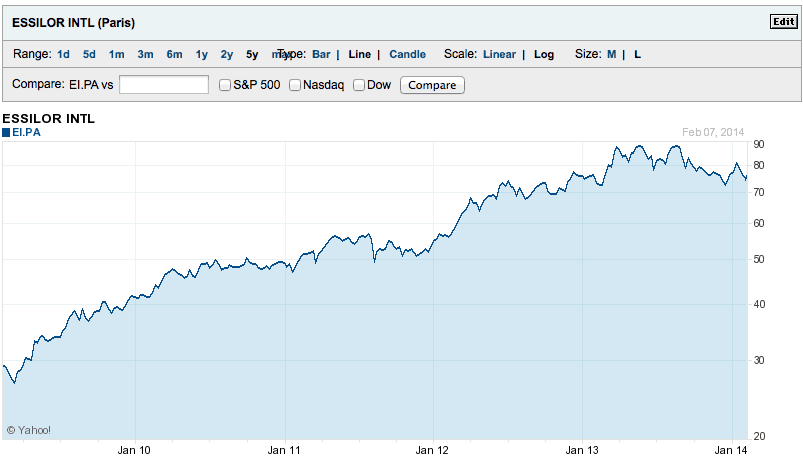
Essilor is a company listed on the French stock market, dedicated to manufacturing lenses. You can see how lucrative the business is.
People also do not stop to think that it is not the same to look far as to look closely, that the correction for myopia is to see well from a distance (ex: driving) but it is not so necessary to see well up close (in fact, it makes vision worse and worse). I have learned all this by following Jake’s videos and website, and now I can confirm it from my own experience. I have also discarded the idea of Lasik surgery. I know that it is a blessing for the quality of life of people with high myopia and that many have done well, but the truth is that what this operation does is giving you a result like wearing contact lenses permanently, in the sense that you see well, yes, but your eyeball is still elongated and your risk on the retina remains the same. The idea of curing myopia is not only to see well again, but also that the elongation of the eyeball changes very slowly and the risk of retinal problems is reduced.
For several years I had been going to work all day in front of the computer, in rooms with heating/air conditioning and with contact lenses, and that is terrorism for your eyes. When you are using the computer/smartphone you blink less and the eye dries, and it dries even more with contact lenses. Heating and air conditioning also dry out the environment, so you should always have a humidifier or a container full of water in the room.
Contact lenses give a better field of vision than glasses and are perfect for the street, going downstairs and playing sports, and for when you really need to see very well from a distance. But to be at home, to work closely, to read, to sew, to perform my dear electric hair removal…no (for that, good magnifying glasses are best). Myopia glasses are for myopia, not for seeing up close. What I started doing almost 3 years ago is to use glasses with a lower prescription than what I use in contact lenses (around one diopter less). And to wear those glasses for close up activities and to be at home. Since this summer I had a “nose job” and wearing glasses is not allowed for a while, I “jumped into the pool” and stopped wearing any type of correction at home. And it was hard, because it is not that I have a little myopia. Today I have a prescription of 4 and 4.5 (when I wrote my first post about myopia, I was 4.75 and 5.25, so you can see that I have improved 0.75 in each eye, in a little less than 3 years). My glasses to be at home and work closely were in 3.25, and I went from that to nothing. I’ve been like this for 5 months now, and I’ve gotten used to it, incredible. I wouldn’t have believed it if someone had told me, because for years the first thing I did when I got out of bed was to put on my glasses. I don’t wear glasses at home or to work. It was quite hard at first, my head ached from the effort, but I got used to it. I get a little closer to the computer screen, but by zooming I have solved it quite well. This may seem silly but what a difference! When looking at the internet, click on the three vertical points in the upper right part of the browser, and then zoom to the maximum that allows you to read the page well. Before I used to read everything at the default size, which is tiny, and of course I had to get very close to the screen. If you spend a lot of time surfing from one page to another, it can be uncomfortable to keep an eye on the zoom, but it is not my case. Also, to write in Word, you can enlarge the screen at the bottom right (I have it at 212%).
There will be people who think that myopia is not a problem beyond the aesthetic issue and the discomfort of walking around with glasses/contact lenses. But you have to be careful when myopia goes beyond 6 or 8 diopters. In that case, it is already what is called high myopia and there is a risk of retinal detachment and even blindness. It’s not a joke. Only a small percentage of the population has myopia in a hereditary/natural way, in most people it is due to the habits acquired over the years and the increasing correction that they wear all day. It is like type 1 and 2 diabetes, the second is acquired and can be corrected. But correcting it takes years and effort to change habits, just as it took me years to start from 0.25 and “just to study and watch TV” to be at 5 diopters and feel disabled without my glasses. You just have to see that the generation of current grandparents, for the most part, never wore glasses to see from afar, but only the correction to see closely when getting old (that is a natural problem, of aging). Asian populations, due to their physiognomy (elongated eyes) have a much higher risk of developing high myopia. Look at this figures, they are outrageous:
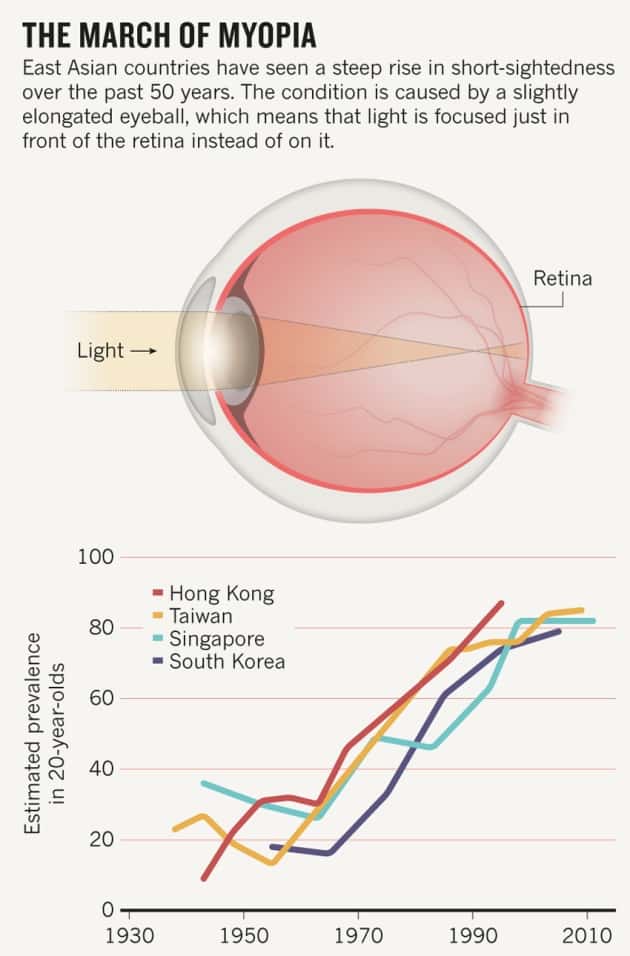
Returning to high myopia, the myopic eye is longer than the non-myopic eye, and that makes the retina thinner and therefore more prone to detachment. In fact, high myopic pregnant women are sometimes even recommended cesarean section instead of natural delivery because of the risk of retinal detachment. For people with high myopia, “violent” activities such as parachuting, roller coasters… are also discouraged due to the risk of retinal detachment.
Since I wrote the first posts about myopia (February and July 2018) to today (November 2020) I have incorporated many new habits to my way of managing myopia. And I have reduced it by 0.75 in each eye, not more because my lifestyle/work inevitably involves working closely, but enough to realize that increasing or decreasing myopia is like gaining/losing weight: a matter of habits. That is why I am going to leave here a list of things that I have learned should be done to improve eyesight. Almost everything I have learned is from Jake Steiner’s videos/web. I hope it’s useful!
1. Begin to wear only glasses (not contact lenses) for office/close-up work: glasses at least 1 diopter less than your current prescription. Glasses should have a clear frame, be as light as possible and with large enough lenses.
2. If possible, try not to wear even glasses for office/close-up work. This is easier when your diopters are low, although I have done it with quite a few but because I am currently working remotely, I understand that in an office it is more complicated.
3. Wear contact lenses outdoors (they provide a broader field of vision) and with total correction for activities such as driving. Indoors, try to have natural light. Try to do fewer close-up activities at night, and if you do them, always use good lighting (don’t look at the computer/smartphone in the dark and with the brightness at the highest).
4. Buy cheap glasses, it can be done online or even in optical stores if they have modest models. The idea with the Jake Steiner method is that diopters are gradually reduced, perhaps 0.25 every 6 months or 1 year. That implies changing glasses once or twice per year.
5. Enlarge the Internet pages, Word … to see them as large as possible when you are working. If possible, use large monitors, the problem with this is that they can induce looking up and to prevent dry eye it is better to look slightly down. This is because looking up opens the eye more and looking down your eyelid covers the eye more, which therefore dries less.
6. Use applications to have breaks when using the computer (with protectyourvision.org every 20 minutes an alarm sounds, so that you look 20 meters away and blink for 20 seconds). Control the brightness of the screens (at night you should reduce it). I recommend the Flux application, which adjusts the brightness level according to the time of day, making the screen more yellow at night (to avoid blue light at that time, which also causes insomnia).
7. Control the humidity level in the room so that the environment is not too dry, do not wear contact lenses indoors. Outdoors, too much sun, wind or pollution also damages dry eye, wearing sunglasses can help.
8. Try to be outside at least 1 hour a day, for example, walking, to look into the distance. Let it be daytime, of course. This, so simple, is difficult for me to accomplish. If you are accompanied, you can do the same as with glasses: even if you wear contact lenses, wear them with a slightly less prescription than prescribed to make a little more effort when looking into the distance. Or if you have low myopia you can even go without graduation, as long as you are accompanied or it is not necessary to see perfectly well.
9. I love reading. And that adds close-up viewing time to what I already have to invest for work. The solution is audiobooks. In addition, this way you can kill two birds with one stone: you can take the opportunity to listen to your audiobook while you walk or are outside and look into the distance. There are many books available in audiobook on Audible. YouTube videos can also be converted to an mp3 version to listen to. The Voice Aloud Reader application reads pdfs aloud, you can select at what speed, mark where you have stopped… I use this application to listen to books that I have in pdf from my smartphone, while I exercise, do chores at home, while I’m waiting in a line…And it’s totally free.
10. Visit the ophthalmologist once a year. It is not enough to go to the optical store. Many opticians are skeptical about the idea that myopia can be improved (obviously it does not suit them for their business) and it may be that in the checkup, if they already know your prescription, they will not tell you that your prescription has dropped. To fix that, you can change your optical store each year and “lie” to them about your current prescription when they have your vision checked. I would not worry too much about this question if you are not a person who drives or performs risky activities that require perfect vision from a distance. The ophthalmologist is going to tell you what your real prescription is. In addition, he looks at the back of your eye to check that your retina is fine, and this is very important. If the ophthalmologist detects micro-tears in the retina, it can be fixed with a laser intervention and prevent a bigger problem.
I hope it helps you, until the next post!

 en.secretsbeautyandhealth.blog