Hello everyone!!
In this month’s post, I am going to talk about a product that, at least until a few months ago, was unknown to me: Retin-A (as they call it in Latin America) or Retirides (known by this name in Spain). If you read my post about acne and Roacután, you will know that I strongly defend its use to defeat acne for good, despite the urban legends and horror stories that some people tell about. I defend it because it went well for me and for all the people I know personally and who had this treatment well, and it’s been like that until today. That said and taking into account that I had this treatment 13 years ago, I have to say that occasionally I have a pimple mainly due to my period, but nothing worrisome. It helps that I am very careful with the products I put on my skin and very scrupulous with hygiene (I never touch my face, I use towels that are exclusive for my face, I change the pillowcase often, I use little and mineral makeup, aloe vera …) . I also take great care of my diet, this and the changes I have made over the years are something that I will talk about in another post.
But getting to the point, in November of last year, I suddenly got one of those horrible-big-painful-pimples with pus in the middle of my face. For me there are serious and non-serious places where you can get a pimple, and in the face, that is, the cheeks, is the worst place. It is the worst place because that is where the serious-cystic-the kind that leaves marks acne occurs. So obviously I panicked, because it hadn’t happened to me in over a decade. Yes, I had the typical pimples in the T zone (forehead-nose-chin) and impurities in my neckline, which is also oily, but not those type of pimples. What I did was wait for the pimple to fully develop, and it took almost 3 weeks!! I tried not to rub it when washing my face, to sleep on the opposite side of my face so as not to spread bacteria, obviously not to put on makeup there…When it had grown up, I put some iodine on it, because I heard that you shouldn’t put alcohol on it, but then I heard the opposite, that you shouldn’t put iodine on it… It ended up disappearing, but left a round red mark, and I didn’t exploit it or anything. To this day you can hardly see it, but that confirms my theory that there are harmless pimples and mass destruction pimples of mass destruction (like that one).
Apart from the food issues that I will address in another post, I began to investigate what could I do, because at the cosmetic-hygiene level I already considered that I did everything well. And that’s where I discovered Retin-A or Retirides. It is an ointment with the same active ingredient as Roacutan (tretinoin) that occurs in concentrations of 0.025%, 0.050% and 0.1%. I saw some videos and blogs that talked about it (the most scientific one: Cómo se aplica el Retirides), and I decided to try it.
The good thing about being an ointment is that it does not pass through the liver or have as much risk to health as Roacután, but obviously its effectiveness is lower and slower. It would be like a light version of Roacután. Doctors recommend starting with the lowest concentration and going up, because it is a strong ingredient and reactions on the skin may occur (redness, skin peeling… I bought it after the horrible pimple because another one came out right next to it, confirming my other theory that bacteria in pimples move… In analogy with what happens now with the virus of the moment, if a mass destruction pimple comes out, you have to take serious measures as soon as possible to prevent it from spreading. And since I only wanted the ointment for that, because I was not willing to buy a bottle of 0.025% or 0.050%, spend it (which could take me months or years, since the recommendation is to apply a very small quantity and only twice a week) and then buy another one with 0.1% concentration. Also, it seems to me that there is quite a difference between the concentration of the first two and the third one. So, I started buying the 0.1%, the maximum concentration. As happens when having Roacután, this ointment can cause the area where you put it to peel (but not your lips constantly or as heavy as it happens with Roacutan), and it causes your skin very sensitive to sun (I have no problem with this because I am very careful, although in my daily routine I do not use sunscreen (normally).
In my case, when I applied it, my skin itched a little, but nothing else. It should always be applied at night and with dry skin. And well, the start of massive destruction on my cheek luckily stopped, applying the ointment to the area twice a week. On the rest of the face I did not dare to put it on, because it is supposed to have the same effect as Roacutan: multiply by 6 the rate at which the skin is renewed and “bring out” hidden comedones. I had no intention of seeing what would happen because the rest of my face is fine so I didn’t want to risk it. I say this because Retin-A is also used a lot to eliminate spots and as an anti-wrinkles ointment: many people use it, let’s say, as an anti-aging cream. What I have done lately is to put it on my nose, to see if it reduces the appearance of pores, and on my neckline, because it is very oily and impurities form. I’ve noticed a great improvement in my neckline, not that much on my nose.
In Mexico Retin-A is sold without a prescription, but in Spain, Retirides must be prescribed by a dermatologist. However, Retirides is sold in Andorra without a prescription, so one can go there or maybe buy it online. In the United States, you can find it as Retinoid.
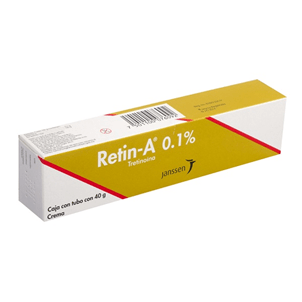
So now you know, if you decide to try this pseudo-Roacutàn, use it with caution!
Until next post!!!
*To buy the products I speak about (I only recommend products that I’ve tested):
As an Amazon Associate I earn from qualifying purchases
*From the United States:
·Retinoid 0.1%: https://amzn.to/35PO2m8
*From Mexico:
·Retin-A 0.1%: https://amzn.to/33Iizzx
*From Spain:
·Retirides 0.1% (disponible sin receta en farmacias de Andorra): https://www.farmaciaenandorra.com/shop/retirides-01-30g
UPDATE!!: read my post Double cleaning: oil+soap
 en.secretsbeautyandhealth.blog