Hello everyone!!
In this month’s post I will continue along the same lines as the previous one, talking about hair discoveries. Given my intention to reduce industrial cosmetics to the maximum or eliminate them completely (news about toxic ingredients in lipstick are nothing new) and my success in covering gray hair with henna, is no wonder I’m not satisfied with just using any supermarket shampoo/conditioner/mask products. Also, since I like to be as minimalist as possible, I have been searching for the simplest formula for months.
Well, I had heard about solid shampoos and about how convenient they are when travelling, but I had not tried them. For a long time I used the traditional yellow Johnson & Johnson (baby shampoo), because shampoos for babies’ ingredients contain less “shit” (although there have also been alarms for toxic ingredients in this type of shampoo). So, I started to look at solid shampoos and I think I have found the one that suits me very well, lasts a long time (another advantage of solid shampoos is that, since they are not diluted in water, they yield more) and it is decently priced for its duration. The shampoo I like is this one:
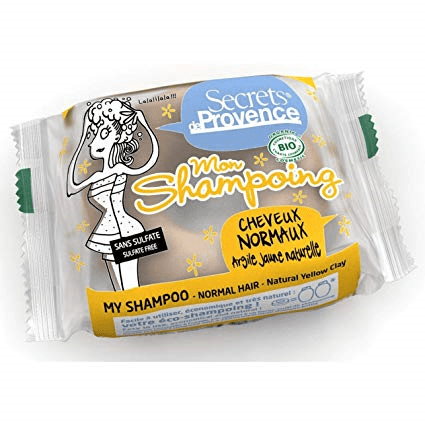
I also bought the container to put the donut-shape shampoo, and in the shower I simply leave it resting on the soap holder, because the hook that came with the shampoo doesn’t work. The ingredients of this shampoo are:
- Disodium Lauryl Sulfosuccinate
- Cetearyl Alcohol
- Triticum Vulgare (Wheat) Starch [1]
- Hydrogenated Castor Oil
- Stearic Acid
- Glycerin[1]
- Aqua (Water)
- Cocamidopropyl Betaine
- Coco Glucoside
- Butyrospermum Parkii (Shea) Butter[1]
- Cocamidopropyl Betaine
- Parfum (Fragrance)
- bentonite (volcanic clay)
- Illite
- Behenyl /Stearyl aminopropanediol esters
- Hydrolyzed Gluten Protein
- Limonene
- Eugenol
- Citral
- Linalool
This shampoo also has versions for greasy, colored, children hair… but its composition does not vary much. I had tried another one that contained the typical caustic soda/sodium hydroxide that grandmothers’ shampoos/soaps used to have and that is still used a lot for homemade cosmetics today, but with that ingredient my hair looked too dull. As I dye my hair with henna, it is normal for my hair to get a little dull in the first wash after dyeing because there is still some mud residue, but by the second wash it is already perfect. And what I do after washing my hair and having it with a towel for 5 minutes is to spray it with white vinegar. Vinegar works as a conditioner for your hair (and for clothes in the washing machine, as well as cleaning the whole house along with baking soda). I use regular white vinegar because it is much cheaper than apple vinegar, and the effect is the same. Don’t worry about the smell because it goes away when your hair dries. And that is all, my friends! Henna, solid shampoo bar and vinegar, the 3 products I use for hair. Very cheap, ecological and non-toxic.
I am not going to dwell too much on the dangers of industrial shampoos, as there are already thousands of articles and blog entries that explain the harmfulness of parabens (endocrine disruptors), silicones (they damage hair) and sulfates (they cause dye to last less and they spoil hair). In addition to that, with industrial shampoos hair lasts clean much less time. The transition from industrial shampoos to natural shampoos can be a bit difficult (we seem to be doing better with industrial shampoos), but it takes a few washes. I do not usually use hair masks, but if I want to use it, I would simply put coconut oil before washing my hair and that’s it. And aloe vera gel works very well as hair gel, although I don’t use it either.
My hair is thick and strong, and although it may seem like an advantage, it is also complicated to deal with. Except when I straighten it, I do not brush my hair every day, only when I’m going to brush it (that is, every 4 or 5 days). And I need a good detangling hairbrush, especially after applying henna. I have looked for hairbrushes that would help me detangle my hair easily, and the two best I have found are these:
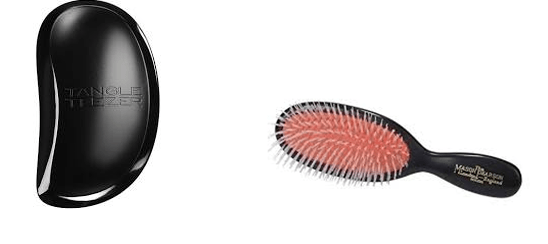
The Tangle Teezer hairbrush detangles very well and is made of plastic, so it is easy to clean in the dishwasher. It detangles very well, you can use it also in the shower with your conditioner (or vinegar). I also bought the Mason Pearson hairbrush because I saw a Victoria’s Secret model recommending it 😊. It has surprised me because it is indeed very good. Since I already had the Tangle Teezer, I bought it in the bag version to carry in my bag (it’s cheaper that way) and I love it. I have it in blue and with nylon bristles (white ones, for thick hair). If your hair is medium (neither very thick nor very fine) there is a version with nylon and boar bristles, and if your hair is very fine with only boar bristles (the dark ones). I already had a boar bristle wood hairbrush, so I bought the nylon one.
For frizz (it happens in humid places and after drying my hair) I sometimes use a wooden comb. It is also good to roll your hair with a microfiber towel or a cotton shirt Anyway, the best thing for frizz is to iron your hair a little.
Finally, speaking of showering, I wanted to take the opportunity to point out that it is not necessary to lather the whole body every time we shower, and less with industrial soaps, because it causes too much dryness. I use the same soap for my body as for the face (Dr.Bronner’s) or a baby one (Mustela). I only use soap daily for my private parts armpits and feet. For the rest of the body, soaping it once a week is more than enough. This way the skin does not dry out so much and you do not need moisturizer after the shower. By the way, the best body creams, in my opinion, are coconut oil and shea butter.
Until next month!!
*To buy the products I speak about (I only recommend products that I’ve tested):
As an Amazon Associate I earn from qualifying purchases
*From the United States:
- Solid shampoo: https://amzn.to/3hNbfb5
- Tangle Teezer hairbrush: https://amzn.to/2EkqGtE
- Mason Pearson hairbrush: https://amzn.to/35RBElu
- Microfiber hair towel: https://amzn.to/2FMBCRg
- Dr. Bronner’s soap: https://amzn.to/2RHjk6u
- Shea butter: https://amzn.to/2FUYLRb
*From Mexico:
- Champú sólido: https://amzn.to/3muRRTE
- Cepillo Tangle Teezer: https://amzn.to/2HhomEP
- Cepillo mini Mason Pearson: https://amzn.to/2H9pGJK
- Toalla turbante de microfibra: https://amzn.to/3iMDU1c
- Jabón Dr. Bronner’s: https://amzn.to/2RHSZp2
- Manteca de karité: https://amzn.to/33MuInn
*From Spain:
- Champú sólido Secrets de Provence: https://amzn.to/35TYlWi
- Cepillo Tangle Teezer: https://amzn.to/3iN5Xh5
- Cepillo mini Mason Pearson: https://amzn.to/33OWKP8
- Toalla turbante de microfibra: https://amzn.to/2FMabXz
- Jabón Dr. Bronner’s: https://amzn.to/3mE033W
- Manteca de karité: https://amzn.to/3iLz44r

 en.secretsbeautyandhealth.blog