Hello!!
In this month’s post I’m going to talk about my new discovery for (facial) skin care. Well it’s not really a discovery because I have been using aloe vera on my face for many years, but now I have switched to real pure aloe vera, straight from the plant. A few years ago, my mother bought an aloe vera plant and we had it on the windowsill in the bathroom. I tried to cut a stalk (leaf) and put the gel on, what was left over we kept in a glass in the fridge. The problem with this method is that there is a lot of gel left over and the gel spoils in a couple of days, even if it is in the fridge. That is why commercial gels, no matter how organic and pure they may be, carry some preservatives (like all cosmetics). Not that this is wrong, but of course I think that if aloe is only aloe, then much better.
That plant died and I did not try the natural method again. Also of course it is much more practical to have the aloe in a container that you take anywhere, put it on and that’s it. For years I used one from the Canary Islands that had very few ingredients, it was called Aloveria. I liked it a lot but they stopped selling it in El Corte Inglés and I didn’t want to spend more to buy it directly from the company, because of the shipping costs. With that and with the proliferation of eco stores and online commerce, I began to buy other brands of aloe on the Internet. I didn’t like them as much as Aloveria but they were organic brands, with pure aloe as the first ingredient, and they were cheap. My skin always felt somehow tight when I put aloe on, I thought it was normal because I had read that aloe, although it hydrates a lot, creates an effect like when you put a facial mask on the skin and it dries. What started to bother me is when I noticed that my skin was peeling a little. This happened with an Italian brand of aloe that I bought online and … surprise! Looking carefully at the ingredients list, I saw that it contained alcohol. I could not believe that I, who supposedly already knew all the tricks of the cosmetic industry, had fallen into that error. All for believing that since it was sold in an organic store it would be very pure and such. So I switched to another (made sure it didn’t have alcohol or too many ingredients). But I was wrong again. It turns out that one day reading a blog I found that now there are pages so that one can see what are the ingredients in cosmetics, for all the controversy that has been going on about lead on lipsticks, carcinogenic ingredients and endocrine disruptors etc. The page that I used is called cosdna.com. I put the ingredients in my new aloe vera gel and it turned out that it contained polymers (a petroleum derivative) and sodium hydroxide. I already talked about sodium hydroxide in another post. It is an irritating and very drying ingredient. Although it is widely used in natural cosmetics, especially to make soaps and shampoos, I think a soap that you rinse is not the same as a gel you put on your skin to absorb it. After investigating I saw that it is precisely something that irritates the skin of many people. So that encouraged me to try the natural method again.
I bought an aloe vera plant for 4 euros in a greenhouse, with its pot included. The aloe vera plant is very easy to care for, you only need to water it once a week and keep it at a warm temperature, tending to hot (between 15-25 degrees). In winter it can simply be kept indoors in an illuminated place, and in summer on a window ledge. It is not recommended to leave aloe in direct sunlight (at least not all day), so that the leaves do not get “burn”.
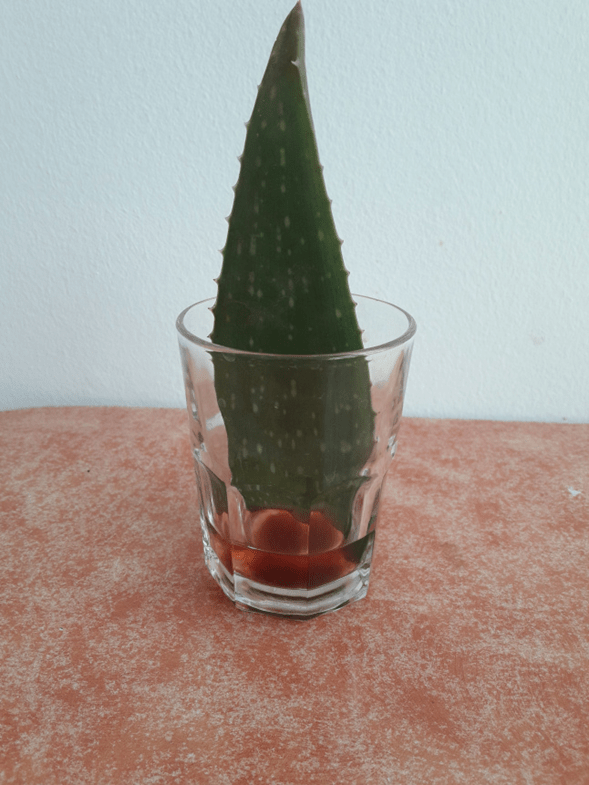
To use aloe vera, what you do is to cut a stalk that is on the outside. That stalk will then grow on its own. You clean any mud and put in a glass with some water on the part where the aloe gel is visible. This is to release the aloin, a kind of iodine that the plant has and that can be irritating. I left the leaf 24 hours and this was the water’s appearance:
The next step is to peel the leaf, making two cuts on the sides and opening it. The gel is removed and, at this time, what can be done is to put it directly in an ice bucket or to liquefy it with a hand rod mixer (and then you distribute the liquid aloe in the ice bucket)(don’t use any water!). If you choose the liquefy method, aloe vera lasts more, since you’re using all the aloe. If you don’t liquefy it you’re just using the liquid on the surface of the aloe pulp. Besides, if you don’t liquefy it, take into account that the aloe vera pulp is a bit messy to handle, it feels like snail drool.
Once the aloe pulp or liquid has been distributed in the ice bucket, it is put in the freezer and in a few hours the aloe cubes can be removed into a Ziploc bag. What I do is to take an ice cube out and put it in a small glass (one of those for shots) and I leave the small glass in the fridge. There the ice cube thaws, and I already have a dose of cold aloe vera, which lasts for about two or three days in pulp, and more if it was previously liquefied. I apply it twice a day, morning and night).
What I have noticed with this new method is that my skin is no longer dry, tight or peeling. You only notice some tightness in the first seconds of putting it on. It seems wonderful to me and it does not involve so much work, in addition to being cheaper than buying commercial aloe gel. The only difficulty I see is when it comes to traveling, for trips of more than 3 days and without access to a refrigerator. If not, just pop a cube or two in an empty cream container and you’re done.
I hope you like this information !! Until the next post!
*To buy the products I speak about (I only recommend products that I’ve tested):
As an Amazon Associate I earn from qualifying purchases
*From Spain:
- Aloe vera puro Aloveria: https://amzn.to/3iNeUGW
 en.secretsbeautyandhealth.blog